
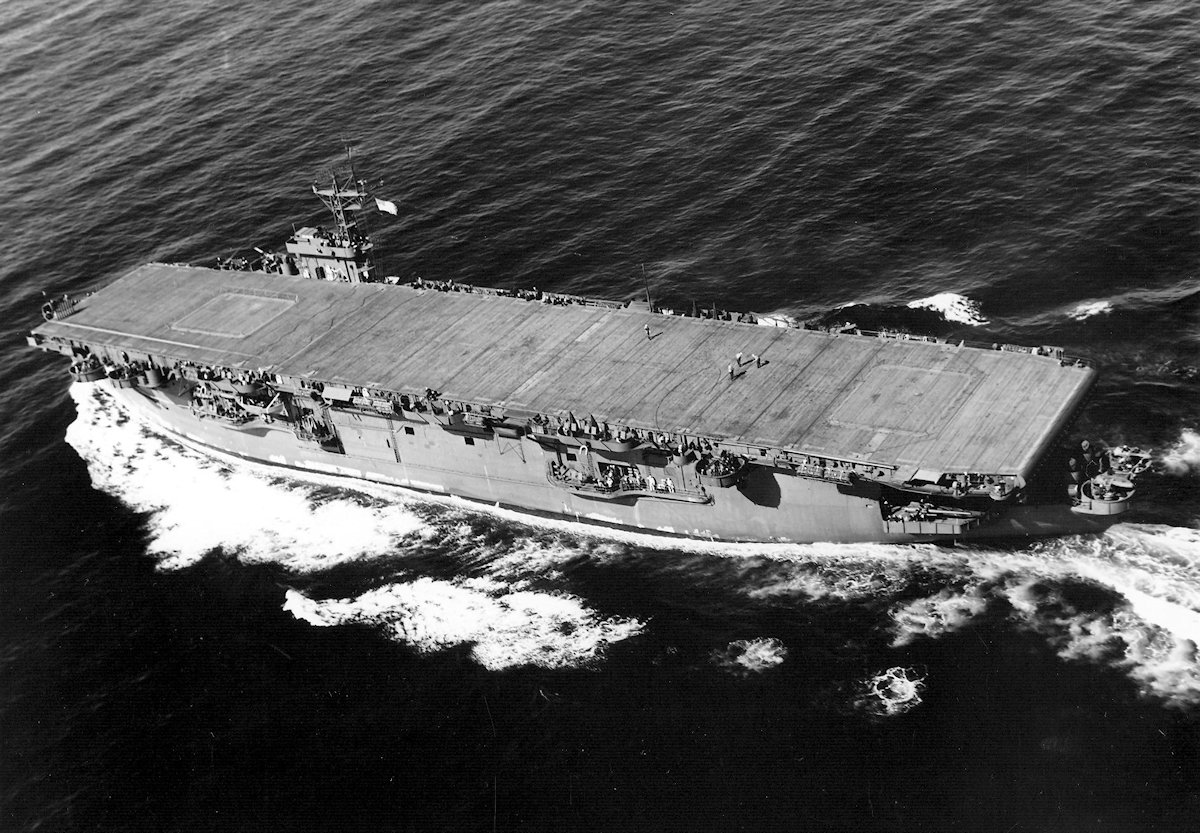
US Navy Escort Carrier USS Breton CVE-23
The USS Breton (CVE-23) was a Bogue-class escort aircraft carrier of the United States Navy that served during World War II and was later reactivated as an aircraft transport vessel in the post-war period. Escort carriers such as Breton played a vital but often underappreciated role in naval aviation and logistics, supplementing fleet carriers and performing transport and support tasks critical to Allied victory in the Pacific.
Design and Construction
The USS Breton was part of the Bogue class which were a series of escort carriers built rapidly under Maritime Commission contracts to address the urgent wartime need for additional air platforms. She was laid down on 25 February 1942 by Seattle-Tacoma Shipbuilding Corporation in Tacoma, Washington, under a Maritime Commission contract. The ship was launched on 27 June 1942 and commissioned into service on 12 April 1943. The vessel was sponsored by Mrs. A. H. Rooks, widow of Captain Albert Harold Rooks, a posthumous Navy Medal of Honour recipient in World War II.
As built, Breton displaced approximately 7,800 tons (standard) with a full-load displacement exceeding 15,000 tons, had an overall length of approximately 495 ft, a beam of 111.5 ft, and a draft of 26 ft. She was powered by steam turbine propulsion feeding a single shaft, capable of propelling the vessel to about 17–18 knots which was modest compared with fleet carriers but suitable for her escort and transport roles. The carrier’s complement was typically around 890–1,205 officers and enlisted men, and she was armed with a combination of anti-aircraft guns, including dual 5-inch mounts and lighter weapons for air defence. The flight deck supported about 24 aircraft, varying with mission profile.
Classification and Early Duties
Breton underwent several reclassifications through her career, reflecting changing roles. Initially designated AVG-23 (Aircraft Escort Vessel) and soon redesignated ACV-23 (Auxiliary Aircraft Carrier) during construction, she received her final wartime designation CVE-23 (Escort Carrier) in July 1943. These reclassifications corresponded to evolving U.S. Navy doctrinal usage of smaller carriers during the early years of the war.
Upon commissioning, Breton completed a working-up period with the Operational Training Command before joining the Pacific Fleet’s Carrier Transport Squadron. During this phase, she also provided carrier operation experience for newly trained pilots and crews.
World War II Service
Transport and Logistics
Unlike fleet carriers that conducted offensive air strikes, Breton’s wartime service was concentrated on transporting aircraft, personnel, and supplies across the vast distances of the Pacific Theatre. Throughout 1943–1945, she operated extensively with the Pacific Fleet’s Carrier Transport Squadron. Her voyages regularly ferried aircraft, replacement crews, fuel, and materiel to front-line units and advanced bases, a mission critical to sustaining offensive operations against Imperial Japanese forces across a dispersed archipelago of islands.
One specific example of her ferrying duties included a December 1943 deployment from Pearl Harbor to Espiritu Santo, New Hebrides (now Vanuatu), carrying a variety of aircraft such as Avengers, Helldivers, Corsairs, Hellcats, and Army Air Forces P-40K Warhawks. At Canton Island, Breton’s crew catapulted the Warhawks and other aircraft off the flight deck to continue on to forward airfields. This was a common practice for delivering land-based fighters where runway infrastructure existed.
Participation in Major Campaigns
While not a frontline combat carrier, Breton’s logistical missions contributed to several pivotal campaigns in the Pacific:
- Capture and Occupation of Saipan (June–August 1944): During the Mariana Islands campaign, Breton delivered aircraft and supplies that supported operations to seize the strategically vital island of Saipan. This effort enabled U.S. forces to establish forward airfields within striking distance of the Japanese home islands.
- Battle of the Philippine Sea (19–20 June 1944): Breton was present in the theatre during this major carrier battle, primarily as a support vessel. While escort and fleet carriers engaged enemy forces directly, logistics carriers like Breton underpinned sustained fleet operations.
- 2nd Bonins Raid (24 June 1944): As part of operations against the Bonin Islands (“Ogasawara Islands”), Breton continued her role in delivering essential aviation assets.
- Assault and Occupation of Okinawa (April 1945): In the final months of the Pacific war, Breton again transported crucial aircraft and supplies in support of the Okinawa operation — the largest amphibious assault in the Pacific Theatre and a key step toward Japan.
For her World War II service, Breton was awarded two battle stars, recognizing her contributions to significant campaigns and operations.
Post-war Decommissioning and Reclassification
After the Allied victory in 1945, Breton returned to the U.S. West Coast in January 1946 and participated in occupation duties before preparing for inactivation. She was placed out of commission in reserve on 30 August 1946 at Tacoma, Washington, joining the Pacific Reserve Fleet as the Navy reduced its wartime force.
Her status remained inactive through the early Cold War period. On 12 June 1955, she was reclassified as CVHE-23, designated an “Escort Helicopter Aircraft Carrier” — a reflection of evolving naval aviation concepts emphasizing rotary-wing operations.
Reactivation as Aircraft Transport (1958–1971)
In 1958, Breton was redesignated CVU-23 (“Utility Carrier”) and transferred to the Military Sea Transportation Service (MSTS), later known as the Military Sealift Command. In this role, she served as an aircraft transport with a civilian crew, supporting peacetime logistical requirements. On 7 May 1959, her designation changed again to T-AKV-42, formally categorizing her as a cargo ship and aircraft ferry.
During this period, Breton transported aircraft, spare parts, and related equipment for U.S. military and allied forces. Photographic evidence from the 1960s shows the carrier delivering fighter jets such as F-104 Starfighters.
She remained in service as a transport until being placed out of service in 1971 and stricken from the Naval Register on 6 August 1972. Shortly thereafter, Breton was sold for scrap, ending her more than three decades of service to the U.S. Navy and its associated logistics arm.


References and Citations
- “USS Breton (CVE-23)” — Wikipedia.
- NavSource Online: Photo Archive Escort Carrier USS Breton (ACV-23/CVE-23 …).
- “USS Breton (ii) (CVE-23)” — uboat.net.
- Service details and commissioning history — Dictionary of American Naval Fighting Ships (DANFS).
- Operational narrative, including ferry missions — johnhenshaw.com.au.
- Postwar aircraft transport information and imagery.