
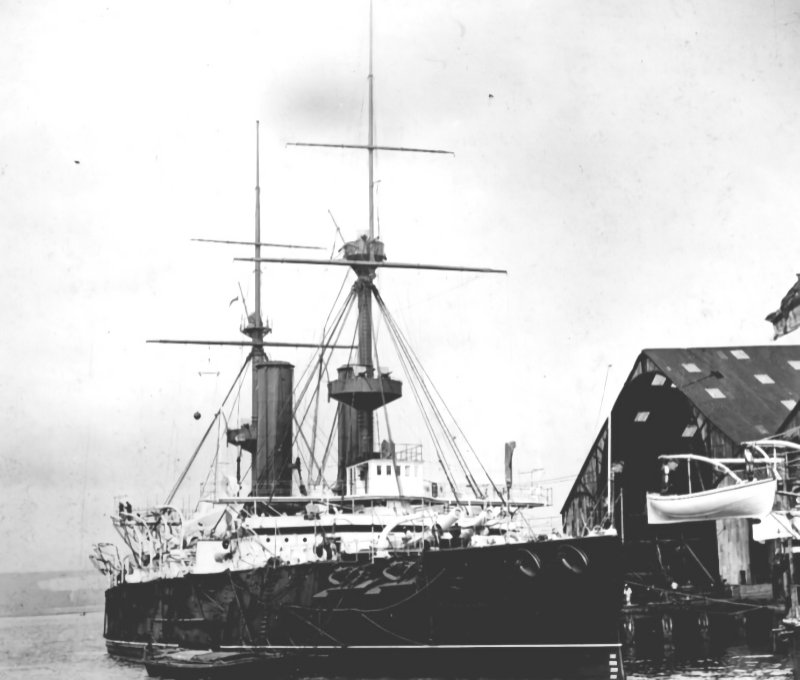
British Pre-Dreadnought Battleship HMS Repulse (1892)
The Royal Sovereign–class, including Repulse, was authorised under the 1889 Naval Defence Act to modernise Britain’s battle fleet. These were high-freeboard, heavy-armour barbette ships designed by Sir William White as successors to the 1880s ironclads. They were heavily armed and armoured for Baltic and North Sea operations. Repulse’s design derived from earlier Admiral-class ironclads but scaled up with a substantial secondary battery (ten 6-inch QF guns) that earlier ships lacked. At the time she was laid down, the Royal Sovereigns represented Britain’s most formidable battleship type: she and her sisters had 13.5-inch main guns and belt armour up to 457 mm (18 in) thick, far heavier than foreign contemporaries. (For comparison, the earlier Majestic class introduced shortly afterward retained 12-inch guns and lighter Harvey armor, gaining weight savings for similar protection.) Repulse’s specifications were roughly: ~14,150 long ton displacement normal, length 380 ft (115.8 m) pp, beam 75 ft, draught 27 ft 6 in. She had two 3-cylinder triple-expansion engines (built by Humphreys & Tennant) rated 11,000 ihp for a design speed of 17.5 kn; on trials she made about 17.8 kn using forced draught. She carried up to 1,420 t coal, giving ~4,720 nm at 10 kn. Armour was compound (not Harvey steel) throughout: a 14–18 in belt amidships and 14–16 in bulkheads, 11–17 in barbette faces, 6 in casemates, 2.5–3 in deck and 12–14 in conning tower.
Construction and Launch
Repulse was ordered under the 1889 Programme, laid down at Pembroke Dockyard on 1 January 1890. She was launched on 27 February 1892; Lady Philipps (wife of the Lord Lieutenant of Haverfordwest) performed the ceremony. After completion of hull and machinery, she was transferred to Portsmouth, where fitting-out finished on 21 April 1894 at a cost of £915,302. HMS Repulse was formally commissioned into the Royal Navy on 25 April 1894, under Captain Burges Watson, relieving the ageing battleship Rodney in the Channel Fleet. Her final as-built appearance matched other pre-dreadnoughts: two very large forward-and-aft barbettes each mounting a twin 13.5-inch turret, with two heavy military masts and a single funnel amidships.
Technical Specifications (Original vs Post-Refit)
| Spec | Original (1894) | Post-1904–05 Refit |
|---|---|---|
| Displacement | ~14,150 LT (standard) | ~14,150 LT (little change) |
| Dimensions (L×B×D) | 380 ft pp × 75 ft × 27 ft 6 in | same |
| Machinery | 2×3-ct HV&T triple-exp engines, 8 cyl boilers | unchanged |
| Power & Speed | 11,000 ihp (design) → ~17.5 kn | ~17.5 kn (no change) |
| Range | ≈4,720 nmi @10 kn | similar |
| Main Armament | 2× twin 13.5 in/30 BL (4 guns total) | Unchanged (4×13.5 in) |
| Secondary Armament | 10×6 in/40 QF casemate guns | Unchanged (10×6 in) |
| Light Guns | 12×6-pdr (57 mm), 12×3-pdr (47 mm) | Slightly reduced (some 3-pdrs removed by 1902) |
| Torpedo Tubes | 7×18 in (450 mm) (4 above-water, 3 submerge) | 3×18 in remained (4 removed by 1902) |
| Armour (belt/turret) | Belt 14–18 in (356–457 mm); barbettes 11–17 in | unchanged (all compound steel) |
| Crew (war) | ~670 officers & men | ~670 (Reserve complement) |
(Note: Refit 1904–05 did not significantly alter Repulse’s armament or armor; changes were mainly routine maintenance and partial removal of torpedo tubes. Her boilers and guns remained as built.)
Refit and Modernisation
HMS Repulse underwent an extensive refit at Chatham Dockyard in 1904–05. Unlike later capital ships, her refit did not add new weapons: the main 13.5-inch and 6-inch batteries were retained, and most light guns remained the same (though the 1902 removal of four fighting-top 3-pdr guns on the barbettes slightly reduced her light armament). Four of her seven 14-inch torpedo tubes (all above-water) had already been removed by 1902, and no new torpedo tubes were added. The refit focused on machinery overhaul and maintenance. By January 1905, Repulse was recommissioned (Captain Henry Tottenham) into the Reserve Fleet, stationed at Chatham with a nucleus crew. Aside from minor changes, she remained essentially the same ship in appearance and combat capability as built, although by this time new battleships with 12-inch guns and Harvey steel made her armament and armour somewhat dated.
Service History
After commissioning in 1894, Repulse joined the Channel Fleet, often acting as flagship. In her early career she took part in the annual fleet manoeuvres (e.g. Irish Sea exercises 1895–96). Notable incidents in this period included a collision with her sister Resolution during manoeuvres on 18 July 1896 (no serious damage), and an internal accident (coal bunker explosion, Dec 1896) that injured 9 men. She stood in for fleet reviews – for example at the 1897 Diamond Jubilee – and remained in home waters through the late 1890s.
From April 1902, Repulse served with the Mediterranean Fleet. She arrived at Malta in April 1902 and joined combined fleet exercises in the Mediterranean that autumn. She completed Mediterranean duties in late 1903, departing Malta in November and arriving Plymouth in December to pay off for refit.
Repulse saw no combat. Her career ended before WWI; after returning from refit and serving in the Reserve Fleet (1905–07), she was used as a Devonport special-service vessel (1907–10) – essentially a training and harbour defence ship under a reduced crew.
Decommissioning and Fate
Repulse was paid off for the final time in February 1911. At that point she was the oldest battleship in the Royal Navy. On 11 July 1911 she was sold to T. W. Ward for scrap at £33,500. She was towed to Ward’s breakers’ yard at Morecambe and arrived on 27 July 1911 for dismantling.


References
- Burt, R. A., British Battleships 1889–1904. Naval Institute Press.
- Conway’s All the World’s Fighting Ships 1860–1905. Conway Maritime Press.
- Parkes, Oscar. British Battleships. Naval Institute Press.
- Phillips, Lawrie. Pembroke Dockyard and the Old Navy. The History Press.
- Silverstone, Paul H. Directory of the World’s Capital Ships. Hippocrene Books.