
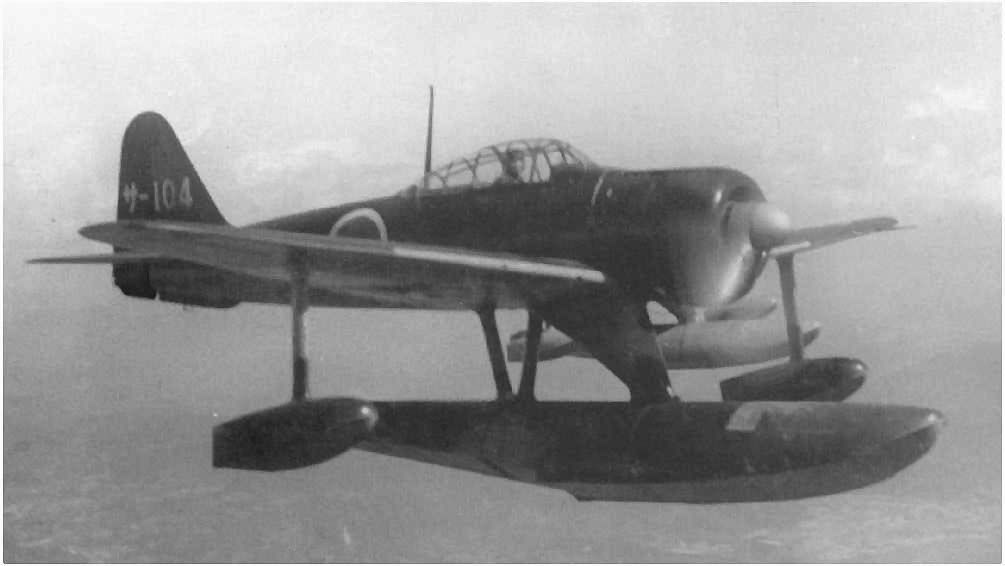
Nakajima A6M2-N Rufe
The Nakajima A6M2-N Rufe was a single-seat floatplane interceptor developed as a stopgap to protect remote island bases and amphibious forces while purpose-built float fighters were pending. It was essentially a Mitsubishi A6M2 Zero (Model 11) modified with a central float and wingtip stabilizer floats. First flown on 7 Dec 1941, it entered service in 1942 and 327 were built. Compared to the land-based Zero, the Rufe was heavier and slower (max speed ~435 km/h vs ~533 km/h), but retained much of the Zero’s agility. It carried the same basic armament (2×20 mm cannons, 2×7.7 mm MGs) and could carry small bombs or rockets. Rufe units primarily served in the Solomon Islands, Aleutians, Dutch East Indies and home waters, operating from seaplane bases and tenders. Early on, many Rufes were lost in the Solomons (e.g. Tulagi, Aug 1942); they saw action intercepting US bombers (B‑17s, B‑24s) and defending island convoys. By 1944 they were outmatched by modern fighters, and production ceased Sept 1943.
Design Origin and Development
- In 1940–41, the IJN recognized a need for a high-performance floatplane fighter to cover remote island bases until field airstrips could be built. While Kawanishi was working on the advanced N1K1 “Kyofu” float fighter, Nakajima was tasked to produce an interim floatplane by converting the existing Zero Model 11. Mitsubishi was too busy to spare production lines, so Nakajima began the “AS-1” project in early 1941 with chief designer Mitsutake Shinobu.
- The first prototype (based on a modified Zero) flew on 7 December 1941. Compared to the Zero, the Rufe’s undercarriage was removed and plated over, and a large central float plus two wing-tip floats were fitted. A straightened rudder and added ventral “keels” under the aft fuselage improved directional stability. Otherwise the Sakae 12 engine and armament were unchanged. Early tests found it generally stable in the air; minor adjustments (flaps, water rudder on the float) solved take-off/landing and turning-on-water issues.
- Officially adopted as the “Navy Type 2 Float Plane Fighter” (Nishiki Suijō Sentōki) on 6 July 1942, the A6M2-N was ordered in quantity (initially ~500). Nakajima’s Koizumi plant delivered 327 aircraft by Sept 1943, falling short of the promised rate due to other priorities.
The floats and additional structures made the Rufe about 13–15% heavier than a Zero. Its top speed (~435 km/h) was roughly 20% below the land Zero. However, due to floats carrying extra fuel (335 L) it could patrol long range (normal ~1,150 km, ferry ~1,780 km). Despite the drag, pilots noted it retained much of the Zero’s legendary agility. In fact, contemporary Japanese sources confirm: “Although its speed fell below that of the Zero, it inherited a considerable portion of the Zero’s outstanding manoeuvrability, and was a very reliable aircraft.”. Turn and climb performance were degraded, but floatplane tactics focused on ambush and patrol rather than dogfights.
Conversion Details (A6M2 → A6M2-N)
Converting the A6M2 Zero to a floatplane involved several key structural changes:
- Float Installation: The retractable landing gear was removed. A single large central float was attached under the fuselage via a streamlined strut pylon. Two smaller fixed floats were mounted under each wing (outside the landing gear wells). The central float included steps and an auxiliary fuel tank (≈320 L). The floats used low-drag design (similar to Kawanishi Kyofu’s) to preserve as much speed as possible.
- Fuselage Modifications: Because adding a large float raised the aircraft’s centre of gravity and made it unstable yaw-wise, the tail was redesigned. The curved end of the Zero’s vertical tail was straightened, and a two-part ventral keel (“twin-skeg”) was added under the rear fuselage. These changes restored yaw stability and compensated for the float’s yawing tendency.
- Control Changes: Flight controls remained largely the same, but pilots reported Rufe had a higher stall speed (due to weight) and different elevator/aileron feel. Small flight control trim changes were made after prototype tests. On water, a hydraulic “water rudder” was fitted to the front of the float to assist in turns.
- Armor and Equipment: Some Rufe versions added a 150 kg pilot’s seat Armor plate and a small teardrop fairing atop the floatstrut (housing an oil cooler). A radio mast was also increased in size.
These modifications added ~230 kg of float hardware (plus 335 L fuel), shifting the Rufe’s empty weight from 1,680 to ~1,912 kg. Nevertheless, handling remained acceptable. Yokohama Kokutai trials noted the Rufe’s controls were “excellent” on land and sea, and only minor tweaks (flap angle, water rudder) were needed.
Operational History
Rufes served mainly in defensive and patrol roles where land-based fighters were scarce. They flew from makeshift seaplane bases (beached or anchored) and seaplane tenders.
- Solomon Islands (Rabaul/Tulagi/Guadalcanal): The first Rufe unit deployed to Tulagi (adjacent Gavutu/Tanambogo) in June–July 1942 to cover impending Guadalcanal landings. On 7 Aug 1942, a strike by 15 F4F Wildcats from USS Wasp destroyed almost all 11 Rufes at Tulagi. Prior to that, in July 1942, Rufe pilots intercepted US bombers: on 10 July two Rufe severely damaged a B‑24 Liberator, and on 17 July they claimed one B‑17. They continued patrols against B‑17 reconnaissance (Aug 1942: heavy damage inflicted on 3 B‑17s) and served in a convoy protection role from Tulagi into late 1942. However, they were largely ineffective against nimble Wildcat and Hellcat fighters once the latter appeared in strength.
- Aleutian Islands/Kuriles: Beginning June 1942, a Rufe detachment of Yokohama Kōkūtai flew to Kiska and Attu (5th and later 452nd Kōkūtai). In the foggy Aleutians they performed patrol and air defence. They scored some notable kills: an RCAF P‑40, a P‑38 Lightning and even a B‑17 bomber were claimed. On 4 Aug 1942, 8 Rufes intercepted B‑24s over Kiska (no kills). After Attu/Kiska fell, surviving Rufes moved to Paramushiro (Kuriles) for homeland defence. Harsh weather, however, caused many losses on the ground.
- Dutch East Indies/Indian Ocean: Rufes were used to guard refuelling bases (e.g. Balikpapan, Avon in Borneo) and escorted convoys. Several operated from the seaplane carrier Kamikawa Maru during Solomon and Kurile operations, and Hokoku Maru/Aikoku Maru raiders in the Indian Ocean. They also did artillery-spotting and long-range reconnaissance flights.
- Home Defense (1944–45): By 1944, with increasing Allied air power, Rufes were relegated to homeland interception (e.g. Otsu Kōkūtai at Lake Biwa defending central Honshu). They were ineffective against USAAF P‑51 Mustangs and B‑29 bombers. Production had ceased in Sept 1943 once the Kawanishi N1K1 (“Rex” float fighter) was available. Rufes survived until Japan’s surrender, even being used in anti-shipping and kamikaze roles late in the war.
- Units operating the A6M2-N: Units known to operate Rufe included the IJN Yokohama, Otsu, Yokosuka, 5th and 452nd Kōkūtai (plus special tenders). Yokohama Koku-tai formed the first Rufe unit in mid-1942, deploying to Rabaul and then Tulagi (Solomons). The 5th Kōkūtai and 802nd Kōkūtai flew Rufes in the Aleutians. The 452nd Kōkūtai (Tokyo-based) received Rufe for Kurile defense later in the war. Some were also assigned to seaplane carriers (Kamikawa Maru, Hokoku Maru, Aikoku Maru) for convoy escort and reconnaissance operations.
Production and Specifications Table
| Attribute | Nakajima A6M2-N “Rufe” | Mitsubishi A6M2 Zero (land) | Remarks |
| First flight | 7 Dec 1941 | 1939 (A6M2) | |
| Introduced | 1942 (wartime service) | 1940 | |
| Manufacturer | Nakajima Aircraft Co., Koizumi Plant | Mitsubishi, Nagoya etc. | |
| Total built | 327 (Dec ’41–Sep ’43) | ~5,000+ (all A6M2 variants) | |
| Engine | Nakajima Sakae 12, 1×14-cyl radial, 940 hp | Same engine (A6M2) | |
| Armament | 2× 20 mm Type 99 cannons (wings) 2× 7.7 mm Type 97 MG (fuselage) | Same as A6M2 | 2× 60 kg bombs optional (some did) |
| Crew | 1 pilot | 1 pilot | |
| Length | 10.10 m | 9.06 m | Floats add length out front |
| Wingspan | 12.00 m | 12.00 m | |
| Height | 4.30 m | 3.26 m (gear retracted) | Waterline height |
| Wing area | 22.4 m² | ~22.5 m² | |
| Empty weight | 1,912 kg | ~1,680 kg | Float hardware added ~230 kg |
| Loaded weight | 2,460 kg | ~2,300 kg (max) | |
| Max speed | 435 km/h @ 5,000 m | 533 km/h @ 4,300 m (A6M2) | –20% speed vs Zero |
| Cruise speed | 296 km/h | ~360 km/h | |
| Range (normal) | 1,150 km | ~1,900 km | Floats carry extra fuel |
| Range (ferry) | 1,780 km | ~3,200 km (with drop tanks) | |
| Ceiling | 10,000 m | 10,000 m (similar) | |
| Climb (to 5,000m) | 6 min 43 sec | ~5 min |
Operational Units and Engagements
Key units and actions involving the Rufe include:
- Yokohama Kōkūtai (25th Sentai) – First to receive Rufe (12 aircraft, Jun ’42); deployed to Tulagi/Gavutu-Tanambogo to cover Guadalcanal construction. Lost most aircraft on 7 Aug ’42 to Wasp Wildcats. Intercepted B‑24s on 10 Jul ’42 (damaging at least one).
- 5th Kōkūtai (Aleutians) – Formed with ~12 Rufe in Aug ’42; operated from Kiska and Attu for air defence. Credited with shooting down a P‑40, P‑38, and B‑17. Based at Attu’s Holtz Bay (image above, Nov ’42).
- 452nd Kōkūtai (Kamikawa Maru) – Took Rufe for Kurile/Northern defence by late 1943.
- 802nd Kōkūtai (Makin/Marshall Is.) – Flew Rufes in late 1942 protecting sea lanes (Japanese sources mention 802nd in Marshalls).
- Otsu Kōkūtai (Lake Biwa) – Equipped with Rufe by 1944 to intercept US bombers/Mustangs near Tokyo.
- Seaplane Carriers and Raids: Kamikawa Maru (Solomons, Kuriles) and raiders Hokoku Maru/Aikoku Maru (Indian Ocean) carried Rufe for convoy escort and reconnaissance.
- French Air Force (post-war) – One Rufe was captured and briefly used by French forces in Indochina after Japan’s surrender (painted with French roundel).


