
Statues of Adelaide South Australia
Scattered around Adelaide are numerous statues and memorials. Below are photos and brief descriptions of some we saw. Besides these, there are many that we did not see. Clicking on the heading s will open a Google Maps link to their location.
Pennington Gardens
Pennington Gardens were designed by August Pelzer, City Gardener from 1899-1932, in the gardenesque style, with formal paths and garden beds. The redevelopment of Adelaide Oval has changed the layout but it retains its formality set with historic statues and a fountain.
Pennington Gardens Fountain (previously known as the Creswell Garden Fountain)
This is a large Victorian-style cast-iron fountain created for the 1885 Adelaide International Exhibition and relocated to Creswell Garden in 1909. It was then relocated from Creswell Garden to Pennington Gardens during the redevelopment of Adelaide Oval in 2014.

Farnese Hercules
The statue of Hercules in Adelaide is a bronze copy of the classical Farnese Hercules, originally excavated at Naples and attributed in turn to the Greek sculptor Lysippos’s fourth-century BCE model.
The donor, William Austin Horn (of the Broken Hill Proprietary Company), presented the statue to the city and it was unveiled in Victoria Square in October 1892. Over the decades it drew controversy: in 1902 letters to the editor objected to his nakedness, and in 1930 one newspaper described him as “grossly misshapen”.
The statue was moved to Pennington Gardens (formerly Laffer Rose Gardens) and, during the redevelopment of the nearby Adelaide Oval, it was repositioned in 2015 near the intersection of paths within the garden to give it greater prominence.

Sir Ross Smith Memorial
The Sir Ross Smith Memorial in Creswell Gardens, Adelaide, stands as a tribute to one of Australia’s greatest aviation pioneers. Unveiled in 1927, the monument honours Sir Ross Macpherson Smith and his brother Sir Keith Smith, who, with mechanics Wally Shiers and Jim Bennett, achieved the first flight from England to Australia in 1919. Their Vickers Vimy aircraft covered more than 18,000 kilometres in just under 28 days, earning them international acclaim and the £10,000 prize offered by the Australian government.
Designed by architect Walter Bagot and sculptor Frederick Brook Hitch, the memorial features a bronze statue of Sir Ross Smith in flying uniform atop a tall sandstone plinth. The base bears bronze reliefs depicting scenes from the historic flight, including the aircraft’s departure from Hounslow and its triumphant arrival in Darwin.
Set among the leafy surrounds of Creswell Gardens near Adelaide Oval, the memorial serves as both a landmark and a site of reflection on Australia’s early aviation history. It symbolises courage, innovation, and the spirit of exploration that defined post-war Australia. The monument remains a focal point for commemorating the nation’s pioneering achievements in flight and engineering.

Adelaide Oval
Established in 1871, the structures and grounds underwent significant redevelopment between 2012 and 2014. It is known for its heritage-listed scoreboard, which stands alongside a new digital scoreboard. Adelaide Oval has been headquarters to the South Australian Cricket Association since 1871 and South Australian National Football League (SANFL) since 2014.
Its record crowd for cricket is 56,298 for the Third Ashes Test on 17 December 2025 and its record crowd for an Australian rules football match is 62,543 at the 1965 SANFL Grand Final between Port Adelaide and Sturt.
There are many statues located in its grounds, mostly honouring cricket and AFL players.
Australian Rules Football
Russell Ebert
Russell Ebert’s sculpture recognises his Hall of Fame career for Port Adelaide in the late 1900s. He won the SANFL best and fairest award a record four times.

Malcolm Blight
An AFL premiership and Hall of Fame player Malcolm Blight won the Brownlow Medal in 1978 and coached the Crows to premierships in 1997 and 1998.

Barry Robran
Barrie Robran was an AFL Hall of Fame Legend. He won the SANFL best and fairest award three times.

Cricket
Sir Don Bradman
This statue commemorates the internationally renowned cricketer Sir Donald Bradman (1908 to 2001) and is located near the eastern entrance to the Adelaide Oval. Designed by Adelaide artist Robert Hannaford and standing 2.5 metres high on a 1.5 metre stone plinth, it was unveiled in February 2002.

Clem Hill
Clem Hill made his debut to elite South Australian cricket in the 1890s at just 16, later captaining Australia. He was the first batsman to make 1,000 runs in a year and this was not repeated for 45 years. He is regarded as one of Australia’ most successful cricketers alongside Donald Bradman and Victor Trumper.

North Terrace
South African War Memorial
The South African War Memorial, unveiled on 6 June 1904, commemorates South Australians who fought in the second South African War (11 October 1899 to 31 May 1902), between Dutch-Afrikaner (Boer) settlers and Britain and her colonies. It was the first war in which South Australians fought overseas. The first South African War was fought in 1880-1881.

Robert Burns
The statue of Robert Burns (1759–96) commemorating the life and work of the Scottish poet and lyricist was the first public sculpture to be made in Adelaide. Made of Angaston marble it was sculpted by WJ Maxwell and unveiled in 1894. It is located outside the State Library of South Australia.

Sir Walter Watson Hughes
The statue of Sir Walter Watson Hughes commemorates one of the founders of the University of Adelaide and its first donor. In 1872 Hughes donated £20 000 to higher education in South Australia, which enabled the establishment of its first (and Australia’s third) university two years later. Hughes founded the chairs of classics, English language and literature, and mental and moral philosophy.

Matthew Flinders
Captain Matthew Flinders (1774–1814) was an early explorer who surveyed most of South Australia’s Coastline. He was the first person to circumnavigate the continent (22 July 1802 to 9 June 1803).

National War Memorial
Located on the corner of North Terrace and Kintore Avenue, next to the grounds of Government House the National War Memorial (South Australia) commemorates South Australians who served in the First World War and those who gave their lives. It was opened in 1931.

Torrens Parade Ground
Vaiben Louis Solomon
This bust commemorates Vaiben Louis Solomon (13 May 1853 – 20 October 1908), the 21st Premier of South Australia and a member of the first Australian Commonwealth parliament.

Pioneer Women’s Statue
Carved from Waikerie limestone by Ola Cohn this statue celebrates the unsung lives of women pioneers.

Vietnam War Memorial
The Vietnam War Memorial was dedicated on 15 October 2006 and dedicated to the 58 servicemen from South Australia who lost their lives in the Vietnam War. During Australia’s involvement in this conflict, more than 60,000 Australians served in Vietnam. The memorial made of bronze and black granite comprises the figures of an Australian and South Vietnamese infantryman standing at rest from patrol, gazing toward the horizon.

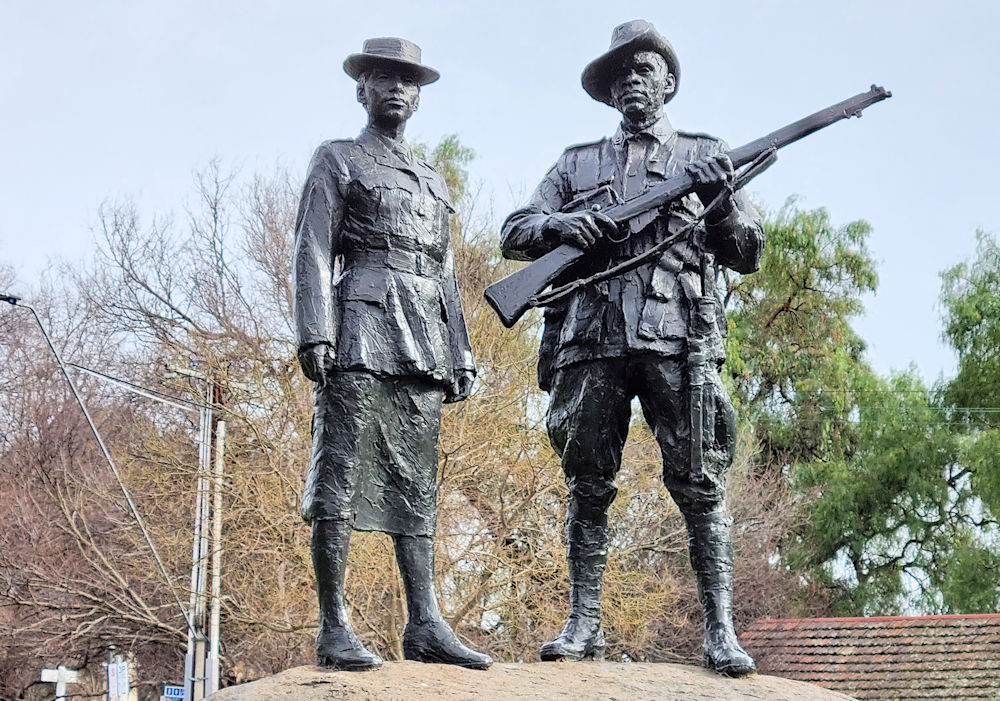
Aboriginal and Torres Strait Islander War Memorial
This memorial honours the bravery of Aboriginal and Torres Strait Islanders during wartime. It was the first such national memorial when it was unveiled in 2013. It recognises a part of war history that until recently has been largely ignored.

Rundle Mall
The Rundle Mall Fountain in front of Adelaide Arcade

The Mall’s Balls
Rundle Mall’s most iconic piece of art is officially known as The Spheres, (but affectionately titled The Mall’s Balls by locals).
The artwork has become one of Adelaide’s main public art attractions, and features two large stainless steel balls of 2.15 metres diameter, sitting one atop the other.
Created by Bert Flugelman to commemorate the newly opened Rundle Mall in 1977, the sculpture was donated by the Hindmarsh Building Society to celebrate their centenary.

Pigeon Statue
Created by artist Paul Sloan, the Pigeon is intended to raise the status of the humble pigeon from an overlooked, ubiquitous creature to the realm of awe and wonder.

The Mall’s Pigs
Officially known as A Day Out this bronze sculpture was created by Marguerite Derricourt and installed on 3 July 1999. It features four pigs, Horatio, Oliver, Truffles and Augusta.


Adelaide Botanic Garden
There are many sculptures scattered throughout the gardens. Below are a few we took photos of.
Amalthea and Jupiter’s Goat

Fountain in the Adelaide Botanic Garden

Victoria Square
Three Rivers Fountain
Named after South Australia’s three main rivers, the Murray, the Onkaparinga and the Torrens the fountain commemorates the visit of Queen Elizabeth II and the Duke of Edinburgh in 1963.. The rivers were represented by human figures and birds with the two smaller rivers having female figures (a woman and a black swan for the Torrens and a woman with a heron for the Onkaparinga). The larger Murray is an Aboriginal male holding an ibis.

Captain Charles Sturt
Charles Napier Sturt (28 April 1795 – 16 June 1869) was a British officer and explorer of Australia, and part of the European exploration of Australia. He led several expeditions into the interior of the continent, starting from Sydney and later from Adelaide. His expeditions traced several of the westward-flowing rivers, establishing that they all merged into the Murray River, which flows into the Southern Ocean. He was searching to prove his own passionately held belief that an “inland sea” was located at the centre of the continent. He reached the rank of Captain, served in several appointed posts, and on the Legislative Council.

Queen Victoria

Charles Cameron Kingston
Charles Cameron Kingston was the Premier of South Australia from 16 June 1893 – 1 December 1899. A strong proponent of Federation, he later represented the state in Federal Parliament from 30 March 1901 – 11 May 1908.

John McDouall Stuart
John McDouall Stuart, often referred to as simply “McDouall Stuart”, was a Scottish explorer and one of the most accomplished of all Australia’s inland explorers. Stuart led the first successful expedition to traverse the Australian mainland from south to north and return, through the centre of the continent.

Leave a Reply