
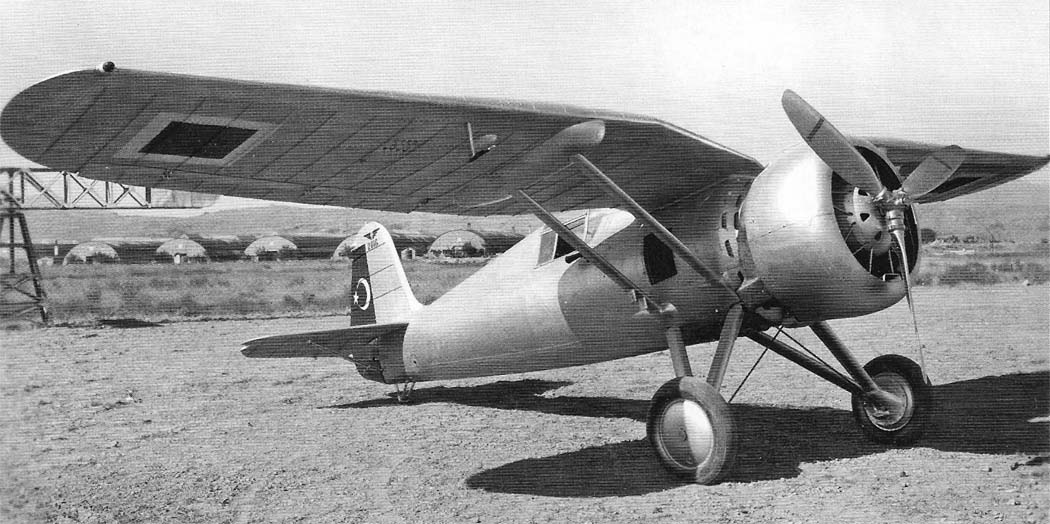
PZL P.24 in Turkish Service
PZL P.24 Overview
The PZL P.24 was a Polish-designed monoplane fighter developed in the mid-1930s by Państwowe Zakłady Lotnicze (PZL). It was a further development of the successful PZL P.11, fitted with the more powerful Gnome-Rhône radial engine. Unlike the P.11, which was primarily for Polish service, the P.24 was specifically intended for export, as licensing restrictions on the British Bristol Pegasus engine (used in the P.11) prevented its sale abroad.
The P.24 featured a gull-wing configuration, open cockpit, fixed undercarriage, and was heavily armed for its time, with versions carrying 2–4 machine guns or 2 machine guns plus 2 × 20 mm cannon. It proved attractive to countries seeking to modernise their fighter fleets in the late 1930s. Although never operated by Poland itself, it became one of the most widely exported Polish aircraft prior to the Second World War.
Use by Turkey
Turkey ordered 14 PZL built P.24As and 26 P.24Cs which were delivered in 1937. Turkish aviation company Kayseri Tayyare Fabrikası (KTF), built a further 6 P.24As and 19 P.24Cs under license. These differed visually by having a pierced engine baffle plate (though some PZL P.24Cs also received this; see the photos of 2125 and 2126 below).
Following the development of the P.24G for Greece, KTF built 2 examples 2146 and 2147 in 1939 for Turkey. Although an order for an additional 20 license built P.24Gs and 2 P.24Fs was placed, the outbreak of the Second World War prevented the delivery of parts from Poland.
Concerns over the low performance of the P.24A resulted in attempts to keep it competitive with more modern fighters. Photos below of 2005 and 2009 with a Gnôme-Rhône 14N of 700 kW (950 HP) as opposed to the original Gnôme-Rhône 14Kfs with 661 kW (900 hp).
The P.24s served as Turkey’s primary fighter force in the late 1930s and early 1940s. As Turkey remained neutral for most of the war, the aircraft did not see combat against foreign powers, though they were used intensively for air defence patrols, training, and exercises.
By the early 1940s, the P.24 was obsolete, and Turkey began to receive more modern aircraft through Allied and Axis channels. The last Turkish P.24s were retired around 1943 with the last one leaving service in 1945.


