
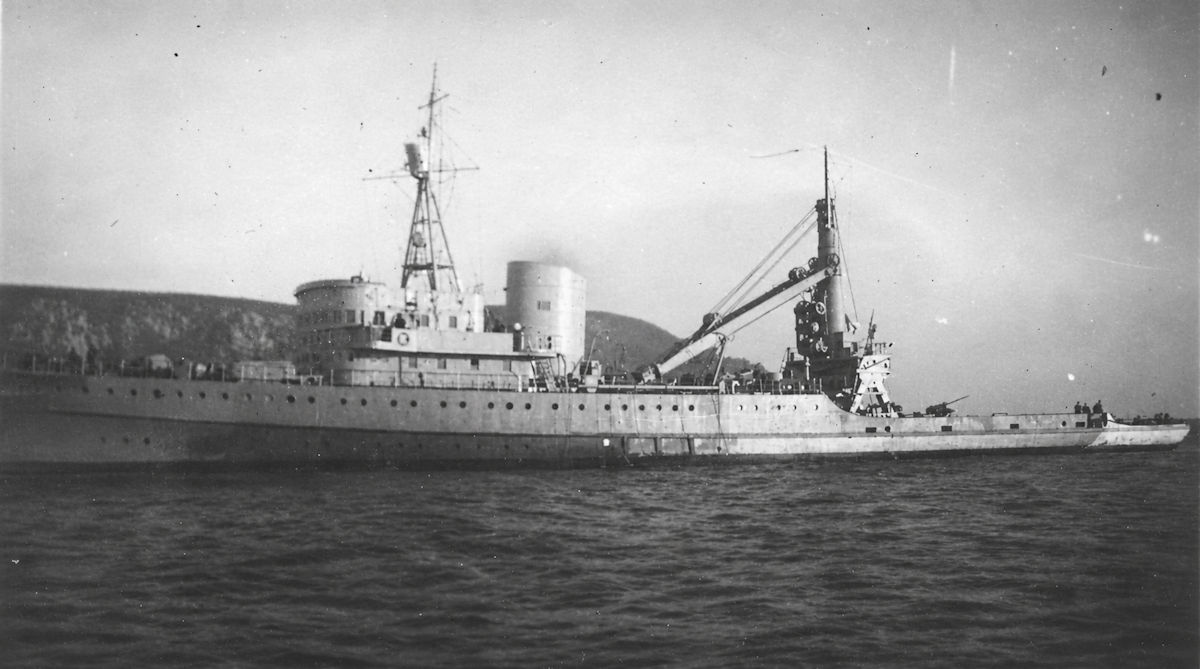
The Hans Albrecht Wedel was a German seaplane tender operated by the Luftwaffe during the Second World War. Classified as a Flugsicherungsschiff (aviation support ship), it provided aircraft recovery, maintenance and air-sea rescue services.
Built by the Schichau shipyard at Königsberg, the vessel was launched on 2 September 1940 and entered service in 1941. It belonged to the K VI class, an enlarged development of the earlier Karl Meyer-class seaplane tenders.
The ship displaced approximately 1,375 tonnes fully loaded and measured 83.8 metres long. Four MAN diesel engines produced 8,800 horsepower, giving a maximum speed of 21.5 knots. Its crew numbered 66 officers and sailors.
An 18-tonne crane enabled the recovery of seaplanes from the water. The vessel could accommodate three aircraft, such as the Arado Ar 196 and Blohm & Voss BV 138. Anti-aircraft guns provided protection against enemy aircraft.
Initially assigned to operations along the French Atlantic coast, Hans Albrecht Wedel later served in Norwegian waters. Its duties included recovering damaged seaplanes and rescuing stranded aircrews.
During 1942 and 1943, the ship participated in several successful rescue operations involving Blohm & Voss BV 138 flying boats.
By late 1944, it operated in the Baltic, supporting German evacuation efforts as Soviet forces advanced. It also assisted with maritime rescue operations.
On 8 April 1945, Soviet aircraft bombed and sank Hans Albrecht Wedel in Danzig Bay. Ten crew members reportedly died. Its loss came just weeks before Germany’s surrender.


