
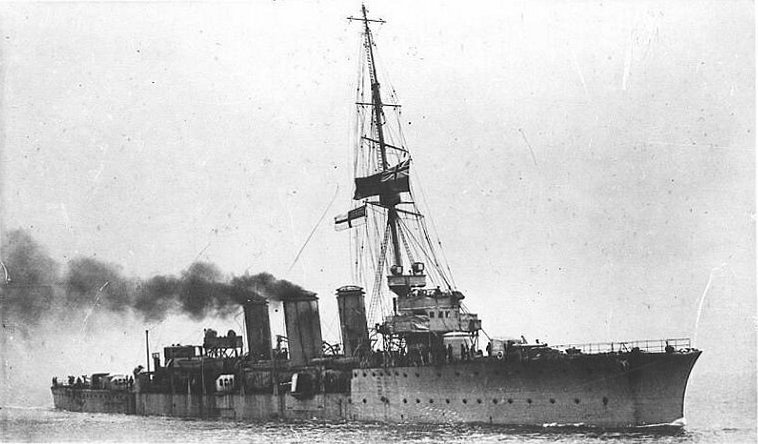
HMS Phaeton (1914) British Light Cruiser
HMS Phaeton (1914) was an Arethusa-class light cruiser built for the Royal Navy during the First World War. Vickers Limited constructed her at Barrow-in-Furness, England. Launched on 21 October 1914, she entered service in February 1915.
Designed as a destroyer leader andfor fleet screening, Phaeton displaced approximately 3,500 tons and could reach 28.5 knots. Her original armament consisted of two 6-inch guns, six 4-inch guns and 21-inch torpedo tubes.
Initially, Phaeton joined the Grand Fleet’s 4th Light Cruiser Squadron. However, she later deployed to the Dardanelles, supporting Allied naval operations during the Gallipoli Campaign. Returning to British waters, she joined the 1st Light Cruiser Squadron. On 4 May 1916, Phaeton and HMS Galatea helped shoot down the German Zeppelin LZ 32 (L 7) over the North Sea. Later that month, Phaeton participated in the Battle of Jutland, serving with British battlecruiser forces. In August 1917, the Royal Navy converted Phaeton for minelaying operations. She could carry 74 mines and subsequently completed five minelaying missions, laying 358 mines.
Following the Armistice in November 1918, Phaeton remained in service briefly before entering reserve. The Admiralty sold her for scrapping on 16 January 1923.


