
Three Days in Kyoto Japan
We had intended to spend three full days in Kyoto Japan. Two days exploring the city, with the third as a day-trip to Himeji. Unfortunately, not everything went to plan, as a typhoon meant our flight out in the evening of day three was cancelled. We were able to change to an earlier flight from Osaka, but this meant all of the planned activities didn’t happen. Fortunately, we saw most of the attractions we really wanted to see on the first day, with Himeji Castle taking up day two.
Even with the shortened stay, we loved Kyoto and will re-visit when we next go to Japan.
Kyoto
Kyoto is one of Japan’s most historic cities, renowned for its ancient temples, traditional streets and beautiful gardens. Located in the Kansai region, Kyoto served as Japan’s imperial capital for more than 1,000 years, from 794 until 1868.
Today, Kyoto preserves much of Japan’s cultural heritage, with over 1,600 Buddhist temples and hundreds of Shinto shrines. Many historic buildings have survived, offering an insight into the country’s past.
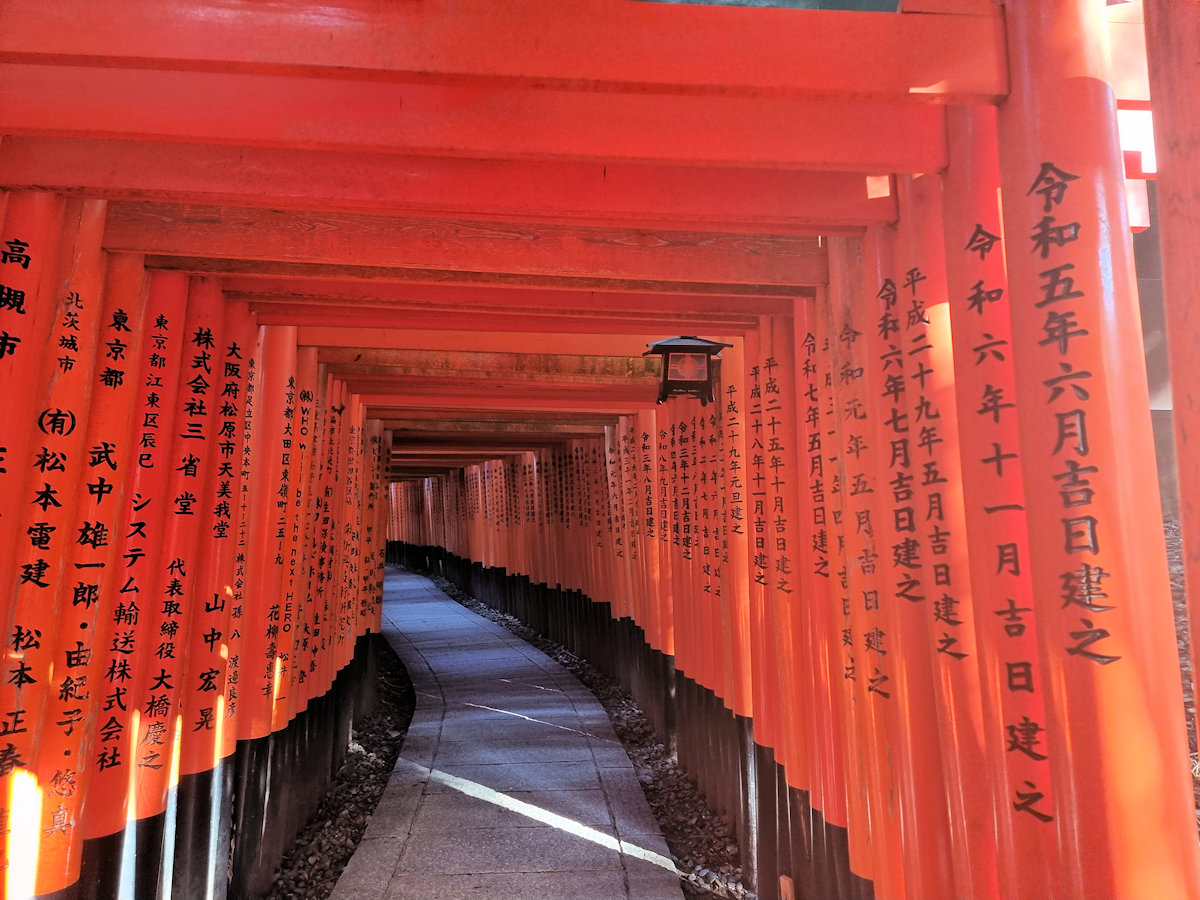
Among Kyoto’s most famous attractions is Fushimi Inari Taisha, where thousands of vermilion torii gates line pathways through the forested mountainside. Meanwhile, Kinkaku-ji, the Golden Pavilion, attracts visitors with its gold-covered exterior reflected in a peaceful pond.
The historic Higashiyama district features narrow streets, traditional wooden buildings and landmarks such as Kiyomizu-dera Temple and Yasaka Pagoda. Nearby, the Gion district remains famous for its traditional architecture and geisha culture.
Other attractions include Ginkaku-ji, the Philosopher’s Path, Arashiyama Bamboo Grove and Nishiki Market.
Kyoto is also an excellent base for exploring the Kansai region, with convenient railway connections to Osaka, Nara and Himeji.
Fushimi Inari Taisha
Our first stop during our Three Days in Kyoto Japan was the Fushimi Inari Taisha, one of Kyoto’s best-known Shinto shrines. Thousands of vermilion torii gates line its mountain pathways, making it one of Japan’s most photographed landmarks.
Founded in 711, the shrine honours Inari, the Shinto deity associated with rice, agriculture and business prosperity. It also serves as the head shrine for approximately 30,000 Inari shrines throughout Japan.
The Rōmon Gate marks the main entrance with its red pillars, tiled roof and traditional wooden architecture. Toyotomi Hideyoshi donated the gate in 1589. Beyond the entrance, you will find the main shrine buildings and several smaller religious structures.
Read the full blog here.

Ginkaku-ji
Ginkaku-ji, officially known as Jishō-ji, is a Zen Buddhist temple located in the eastern hills of Kyoto. Originally established as a retirement villa for the shogun Ashikaga Yoshimasa in the late 15th century, it was converted into a Buddhist temple following his death in 1490.
Despite its name, the Silver Pavilion was never covered in silver. Its simple wooden exterior reflects the understated elegance of the Higashiyama culture that developed during Yoshimasa’s lifetime.
One of the temple’s most distinctive features is its carefully maintained sand garden. Known as the Sea of Silver Sand, it features precise patterns raked into white sand, alongside the distinctive cone-shaped Moon-Viewing Platform.
Read the full blog here.

Higashi Hongan-ji
Located a short walk from Kyoto Station, Higashi Hongan-ji Temple is one of the city’s largest and most important Buddhist temples. Officially known as Shinshū Honbyō, it is the headquarters of the Ōtani branch of Jōdo Shinshū Buddhism, a tradition founded by the monk Shinran in the 13th century.
The temple was established in 1602–1603 following a division within the Hongan-ji Buddhist community. Tokugawa Ieyasu granted land to the priest Kyōnyo, who established a separate temple east of the original Hongan-ji. The two institutions subsequently became known as Higashi (Eastern) Hongan-ji and Nishi (Western) Hongan-ji.
Read the full blog here.

Hōkan-ji Temple (Yasaka Pagoda)
Hōkan-ji Temple, better known as Yasaka Pagoda, is in Kyoto’s historic Higashiyama district. Its five-storey wooden pagoda rises 46 metres above the surrounding traditional streets.
According to tradition, Prince Shōtoku founded the temple in 589 following a divine message in a dream. However, fires destroyed the original structures several times. Consequently, the present pagoda dates from 1440, when shogun Ashikaga Yoshinori ordered its reconstruction.
The pagoda features five curved tiled roofs and wooden construction. Although the original temple complex occupied a larger area, only a few structures survive today.
Read the full blog here.

Kiyomizu-dera
Kiyomizu-dera is one of Kyoto’s most famous Buddhist temples, standing on the wooded slopes of Mount Otowa. Its elevated position offers impressive views across Kyoto and the surrounding hills.
Founded in 778, the temple honours Kannon, the Buddhist deity of compassion. Over the centuries, fires destroyed many of its buildings. Most surviving structures date to 1633, during the Edo period. UNESCO recognised Kiyomizu-dera as part of the Historic Monuments of Ancient Kyoto in 1994.
Read the full blog here.

Yasaka Shrine
Yasaka Shrine is one of Kyoto’s most important Shinto shrines, located at the eastern end of the historic Gion district. According to shrine tradition, its origins date to 656, although historical accounts differ regarding its foundation. The shrine honours Susanoo-no-Mikoto, his wife Kushinadahime-no-Mikoto and their eight children.
It has a long association with Kyoto’s famous Gion Matsuri festival. The festival began in 869, when residents sought divine protection against a devastating epidemic. Today, the annual July celebrations include decorated floats, religious ceremonies and processions through Kyoto.
Read the full blog here.

Himeji Castle Day Trip
Although not located in Kyoto, we visited Himeji as a day trip. This simplified travel, accommodation and moving luggage. We caught the train from Kyoto Station to Himeji Station. This took around 90 minutes with a cost of JPY 2,110 (September 2026). The castle is amazing and really is a must-see for anyone visiting Japan.
Read the full castle blog here.
Besides the castle, we visited the Koko-en Garden while in Himeji. This is a beautiful traditional Japanese garden. Only a few minutes’ walk from the castle, it’s a great way to relax after the crowds elsewhere in the city.
Read the full garden blog here.


To find out more about Japan, see our blogs here
Leave a Reply