
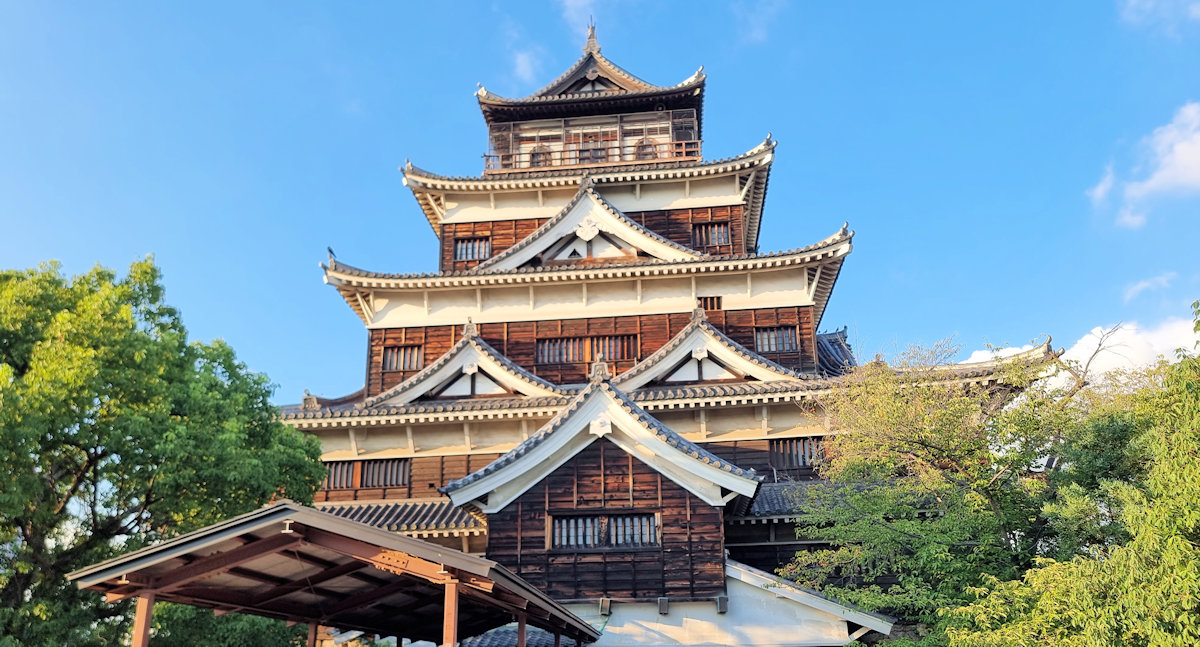
Hiroshima Castle
Hiroshima Castle, also known as Carp Castle (Rijō), is one of Hiroshima’s most recognisable historical landmarks. Originally constructed in 1589 by the powerful feudal lord Mōri Terumoto, the castle served as an important military and administrative centre during Japan’s feudal period.
Unlike many Japanese castles built on hills, it was constructed on flat land, surrounded by defensive moats and substantial stone walls. The castle later became the residence of the Fukushima and Asano clans, who governed the region during the Edo period.
Much of the castle was dismantled in the Meiji era. On 6 August 1945, the remaining structure was completely destroyed by the atomic bomb dropped on Hiroshima. In 1958, the five-storey main keep was reconstructed using reinforced concrete, closely resembling its original appearance. The reconstruction became an important symbol of Hiroshima’s recovery following the war.
Visiting Hiroshima Castle
The main castle was permanently closed to visitors on 22 March 2026 because of structural deterioration and safety concerns. Visitors can no longer enter the keep or access its former museum and observation deck. However, its exterior remains visible, allowing you to appreciate the traditional architecture and photograph the castle.
The surrounding grounds remain accessible, including the impressive moat, historic stone walls and reconstructed Ninomaru buildings. These provide an opportunity to explore the castle’s history despite the closure of the main keep.
How to Get There
Hiroshima Castle is located in central Hiroshima, approximately 15 minutes’ walk from the Kamiyacho-higashi or Kamiyacho-nishi tram stops.
From Hiroshima Station, take tram line 1, 2 or 6 and walk from the Kamiyacho area. Alternatively, use the Hiroshima sightseeing loop bus, known as the Meipuru-pu, which serves major attractions.
The castle is also approximately 30 minutes’ walk from Hiroshima Peace Memorial Park, making it easy to combine both attractions in one visit.


To find out more about Japan, see our blogs here
Leave a Reply