
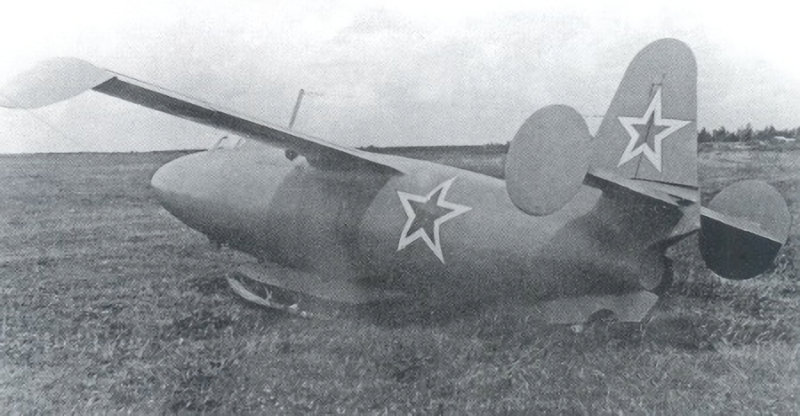
Florov 4302 Experimental Rocket Plane
The Florov 4302 was one of the Soviet Union’s last serious attempts to develop a rocket-powered interceptor before turbojet technology rendered the concept obsolete. Designed by Ilya Florov at the same design bureau that had produced the pioneering Bereznyak-Isayev BI-1, the aircraft represented a significant advance over its wartime predecessor. Development began in 1944, although the first prototypes were not completed until after the Second World War.
The 4302 was an all-metal shoulder-wing monoplane with straight wings featuring sharply drooped outer wing panels. These downward-angled wingtips were intended to improve lateral stability and reduce wingtip vortices. The aircraft also incorporated small endplate fins on the horizontal tailplane, a distinctive feature inherited from earlier Soviet rocket aircraft research. The fuselage was compact and highly streamlined, reflecting the designers’ emphasis on achieving the highest possible speed with limited rocket endurance.
Three substantially different prototypes were built during 1946–47. The first, designated 4302/I, lacked conventional landing gear and was carried aloft beneath a Tupolev Tu-2 before being released for powered flight. After completing its mission, it landed on a retractable skid. This approach simplified the aircraft and reduced weight while allowing engineers to evaluate its aerodynamic characteristics.
The second prototype, 4302/II, introduced a detachable launch trolley, allowing independent take-off under rocket power. Powered by a single-chamber Alexei Isayev liquid-fuel rocket engine producing approximately 10.8 kN of thrust, it achieved a recorded speed of 826 km/h (513 mph) at an altitude of 5,000 metres during tests in August 1947. Test pilot A. K. Pakhomov conducted much of the aircraft’s flying programme, demonstrating satisfactory handling despite the aircraft’s extremely high thrust-to-weight ratio and short powered flight duration.
The final prototype received a more powerful two-chamber Dushkin-Glushko RD-2M-3 rocket engine generating around 13.7 kN of thrust. The two-chamber arrangement allowed the pilot to use one combustion chamber for cruising and both chambers simultaneously for maximum performance, improving fuel economy compared with a single large chamber. Despite these refinements, endurance remained extremely limited, with powered flight lasting only a few minutes before fuel exhaustion.
By the time flight testing was underway, the rapid development of turbojet-powered fighters such as the Mikoyan-Gurevich MiG-9 had demonstrated that pure rocket interceptors offered little operational value. Although rockets provided spectacular climb performance and acceleration, their very short burn time left little opportunity to intercept enemy aircraft or return safely. The same conclusion ended the development of several similar Soviet and German-inspired rocket aircraft projects.


