
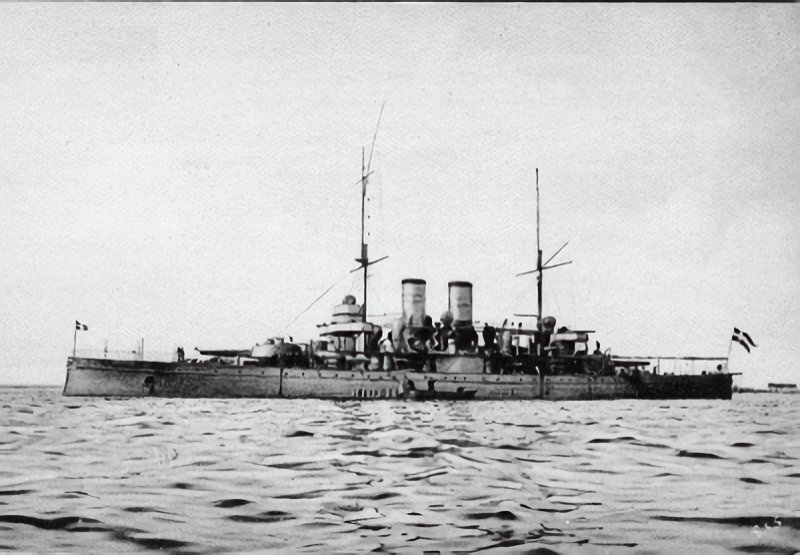
Swedish Navy Coastal Defence Ship HSwMS Dristigheten
HSwMS Dristigheten was a Swedish coastal defence ship (pansarskepp) commissioned in 1901, the sole ship of her class, designed for Baltic defence. Slightly larger than her predecessors (the Oden-class), she carried two 21 cm guns and six 15.2 cm guns, with Harvey-steel armour up to ~200 mm thick. Built at Lindholmen (Göteborg) and launched 28 April 1900, she served in Sweden’s neutral fleet through World War I without combat, underwent refits in 1922 (minor armament modernisation) and 1927–30 (conversion to a seaplane depot ship), and was decommissioned in 1947. Thereafter she was used as a target, sank during gunnery practice in 1960, salvaged and sold for scrap in 1961. Technically, Dristigheten was a transitional pre-dreadnought coastal battleship: compared to the preceding Oden class she sacrificed one notch of gun calibre (two 21 cm guns instead of two 25.4 cm) in exchange for faster firing and more medium-calibre guns. Her strengths lay in heavy armour and robust construction suited to the confined Baltic, while weaknesses included limited range and speed by emerging dreadnought-era standards. In comparison to contemporaries, she was broadly similar to other small coastal battleships of the period, and her later aircraft-tender conversion made her unique in Swedish service.
Technical Specifications
The ship’s original 1901 specifications included overall length 86.9 m (waterline), beam 14.78 m and draft 4.88 m. Displacement was 3,200 tons standard (approx. 3,600 tons full load). She had two triple-expansion steam engines (5,400 ihp total) and eight Yarrow boilers, driving two shafts. Her design speed was 16.5 knots . Range was on the order of 2,900 nautical miles at 10 knots which was sufficient for Baltic operations.
Armament (original, 1901): two 21 cm/44 Bofors M/98 guns (one twin turret fore and aft), six 15.2 cm/44 Bofors M/98 guns in armoured casemates (three per side), ten 57 mm/55 rapid-fire guns (for torpedo boat defence), and two 45.7 cm submerged torpedo tubes. The armour scheme featured Harvey-steel protection: a main belt of 200 mm, turret faces of 200 mm, and 25 mm deck plating. Crew complement was about 260–270 officers and men at launch.
Refit and Modernisation History
Post-1910 Service: In 1911 Dristigheten’s foremast was strengthened into a tripod to support a new optical rangefinder, reflecting pre-war upgrades. She remained in reserve during World War I, since Sweden stayed neutral, serving in patrol and training roles.
1922 Overhaul: In the early 1920s Dristigheten received an ordnance refit. Two of her ten 57 mm guns were replaced by dual-purpose 57 mm AA guns (Bofors m/16 and m/19) mounted on turret roofs. The main 21 cm and 15.2 cm batteries were retained unchanged. The secondary armament layout after 1922 was thus 2×210 mm, 6×152 mm, 8×57 mm, plus 2×57 mm AA guns; torpedo tubes were removed. These modifications brought the ship’s crew to about 380.
1927–1930 Conversion: Recognizing the rise of naval aviation, Sweden converted Dristigheten into a floatplane depot ship. During 1927–30 her aft 21 cm turret and most 57 mm guns were removed. A new aft superstructure was built with a hangar and workshops, and deck space aft for aircraft. Four 75 mm AA guns (m/26–28) and two 40 mm AA guns (m/36) were installed for air defence, along with four 8 mm machine guns. Cranes were fitted to hoist two to three floatplanes (typically Heinkel HD 16/HD 19 biplanes) on and off the water. At conversion she displaced much less (about 2,270 tons post-conversion) and carried about 427 crew (including aviation personnel). This final configuration made her unique among Swedish ships as a hybrid cruiser and seaplane tender.
The table below summarises key specifications:
| Spec | Original (1901) | Post-1922 refit | Post-1927 conversion |
| Displacement | ~3,200 t standard; ~3,600 t full load | ~3,200/3,600 t (unchanged) | ~2,270 t (≈ post-conversion) |
| Dimensions (L×B×D) | 86.87×14.78×4.88 m | same | same (no hull change) |
| Machinery/Power | 2×3-ct TE engines, 8 boilers, 5,400 ihp | unchanged | unchanged |
| Speed | ~16.8 knots | ~16.8 knots | ~16 knots (lightened but superstructure) |
| Range | ~2,900 nm @10 kn | similar | somewhat reduced |
| Main Armament | 2×210 mm/44 (fore/aft turrets) | 2×210 mm (same) | Removed |
| Secondary Armament | 6×152 mm/44 (3 per side) | 6×152 mm (same) | 4×75 mm AA (m/26–28) |
| Light AA/GB | 10×57 mm L/55 guns | 8×57 mm + 2×57 mm AA | 2×40 mm AA + 4×8 mm MG |
| Torpedo Tubes | 2×45.7 cm (submerged) | Removed | Removed |
| Armour (belt/turret) | ~203 mm / ~203 mm | unchanged | Armour largely removed |
| Crew Complement | ~262 (war establishment) | ~380 | ~427 (incl. air crew) |
Service History
In peacetime Dristigheten conducted routine training and readiness duties. Her one significant pre-WWI deployment was a winter cruise in 1906–07, visiting ports in Germany, Britain and then south through the Mediterranean and North Africa, returning to Karlskrona by April 1907. She was reviewed by King Oscar II on several occasions in the early 1900s, reflecting her status as a modern capital ship. Otherwise until 1914 she remained in Baltic waters alongside the Oden-class and newer Äran-class battleships.
World War I (1914–18): Sweden’s neutrality meant Dristigheten saw no combat. She served in the home fleet enforcing Swedish territorial waters. A modest overhaul was done in 1911 (mast modification) and again in 1922 as noted above. She maintained coastal patrol duties throughout.
Interwar period: Aside from armament refits, Dristigheten took part in fleet exercises and goodwill visits. Notably, she was stricken from front-line duty when converted in 1927. After conversion, in 1930–39 she served as the flagship of the Flygkårsförvärvsdivisionen (the Coastal Fleet’s aviation support wing), operating seaplanes from her decks for coastal reconnaissance.
World War II (1939–45): At the outbreak of war in 1939, Dristigheten was mobilised into Sweden’s Kustflottan (Coastal Fleet). She joined a reconnaissance squadron with the cruiser Gotland and several torpedo boats. However, by then her engines and boilers were aging: frequent mechanical failures forced her to halt often, relegating her to harbour defence duty. When Germany invaded Norway/Denmark (April 1940), Dristigheten was in a Stockholm dockyard undergoing inspection for repairs. After partial fixes, she spent the war heavily camouflaged and essentially static. Sweden’s strategic requirement was only for her to “blockade” the Baltic entrance in case of neutrality violations.
Decommissioning and Fate
After WWII, Dristigheten was obsolete. She was officially stricken on 13 June 1947. Rather than immediate scrapping, she was retained as a gunnery target. In the summer of 1960 she was towed out to sea and subjected to live-fire exercises by Swedish destroyers and aircraft. Hit by bombardment, she sank in the Karlskrona archipelago at about 10 m depth. Since she still protruded above water, authorities decided to salvage her. A cofferdam of wooden planks was built around the wreck; after pumping out water she was refloated and returned to Karlskrona drydock. In 1961 she was sold to a Gothenburg firm and broken up for scrap.
| Displacement | 3445 t |
|---|---|
| Length | 86.87 m (285 ft 0 in) |
| Beam | 14.78 m (48 ft 6 in) |
| Draught | 4.88 m (16 ft 0 in) |
| Installed power | 8 Yarrow boilers, 5,400 ihp (4,000 kW) |
| Propulsion | 2 screws; 2 triple-expansion engines |
| Speed | 16.5 knots (30.6 km/h; 19.0 mph) |
| Range | 2,040 nmi (3,780 km; 2,350 mi) at 10 knots (19 km/h; 12 mph) |
| Complement | 262 |
| Crew | 427 |
| Armament | As coastal defense ship 2 × single 21 cm (8.3 in) guns 6 × single 15.2 cm (6 in) guns 10 × single 5.7 cm (2.2 in) guns 2 × single 45.7 cm (18 in) torpedo tubes As an aircraft tender, 1930 4 x 75 mm (2.95 in)/50 cal AA 2 x 40 mm (1.57 in)/60 cal AA 4 machine guns |
| Armour | Harvey armour Belt: 200 mm (7.9 in) Turrets: 200 mm (7.9 in) Deck: 25 mm (1 in) |
| Aircraft carried | 3 floatplanes |
| Aviation facilities | Crane |


