
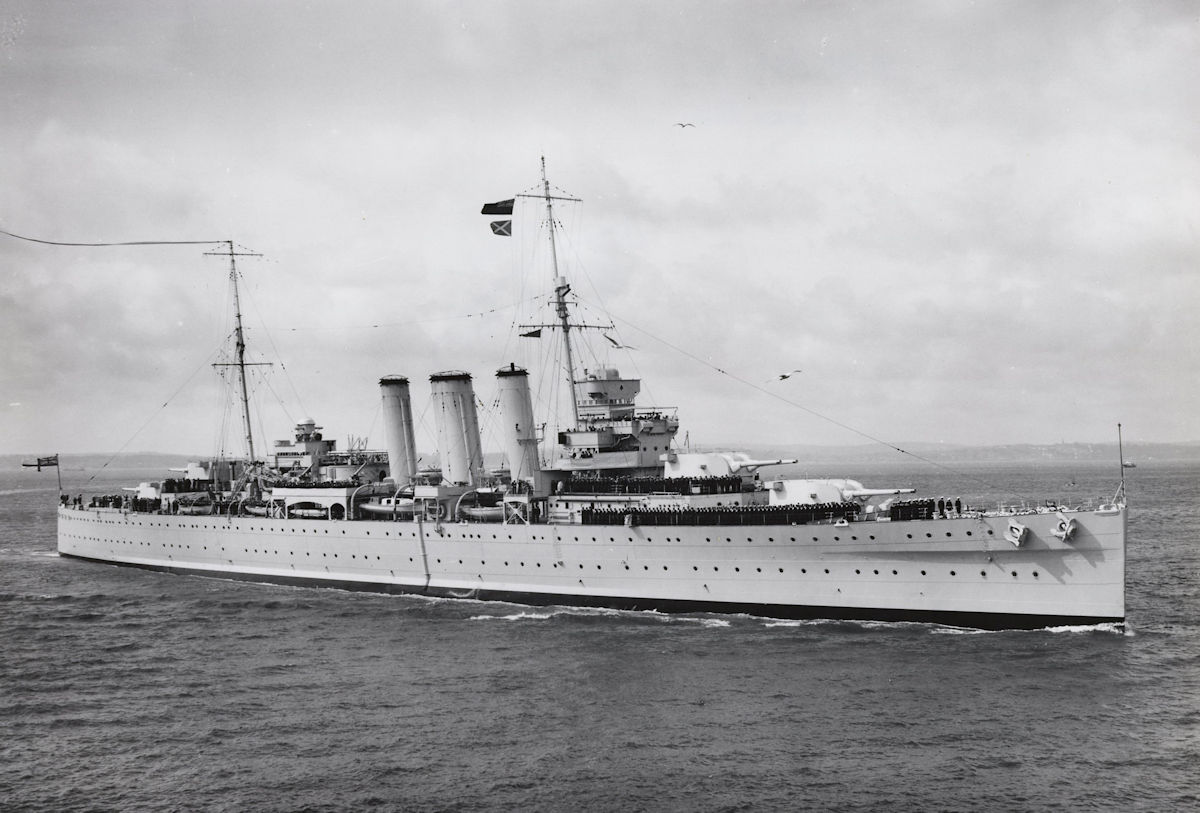
HMS Cornwall (1928) British Heavy Cruiser
The British heavy cruiser HMS Cornwall was one of the Royal Navy’s County-class cruisers built during the interwar period. Commissioned in 1928, she was designed under the limitations of the Washington Naval Treaty, which restricted the size and armament of cruisers. As a result, Cornwall displaced around 10,000 tons and carried eight 8-inch guns mounted in four twin turrets. Named after the English county of Cornwall, the ship became an important part of British naval operations during the Second World War.
Constructed at Devonport Dockyard, HMS Cornwall featured a long-range cruising capability that made her especially valuable for imperial defence and overseas patrol duties. Before the war, she served extensively on foreign stations, particularly in the Indian Ocean and the Far East, where Britain sought to protect trade routes and colonial interests. Her combination of speed, firepower, and endurance reflected the Royal Navy’s continuing reliance on cruisers to police the vast reaches of the British Empire.
When the Second World War began in 1939, HMS Cornwall was quickly drawn into active service. Early in the conflict she operated in the Indian Ocean and South Atlantic, escorting convoys and hunting German commerce raiders that threatened Allied shipping. In 1941 she played a significant role in the pursuit of the German auxiliary cruiser Pinguin, a disguised raider responsible for sinking or capturing numerous merchant vessels. Cornwall intercepted and destroyed the raider in May 1941, helping secure Allied trade routes in the region.
In early 1942 HMS Cornwall became part of the British Eastern Fleet under Admiral Sir James Somerville. The fleet attempted to counter the growing Japanese naval threat in the Indian Ocean. During the Indian Ocean Raid in April 1942, Japanese carrier aircraft under Admiral Chuichi Nagumo launched devastating attacks against British naval forces and bases. On 5 April 1942, HMS Cornwall and her sister ship Dorsetshire were detected south-west of Ceylon (modern Sri Lanka) by Japanese reconnaissance aircraft.
Shortly afterward, waves of Japanese dive-bombers attacked the two cruisers. Despite attempts to manoeuvre at high speed and defend themselves with anti-aircraft fire, Cornwall proved highly vulnerable to aerial attack. She was struck repeatedly by bombs, causing severe fires and flooding. Within a short period, the cruiser capsized and sank. More than 190 officers and sailors lost their lives, while many survivors spent hours in the sea before being rescued by British naval vessels.


