
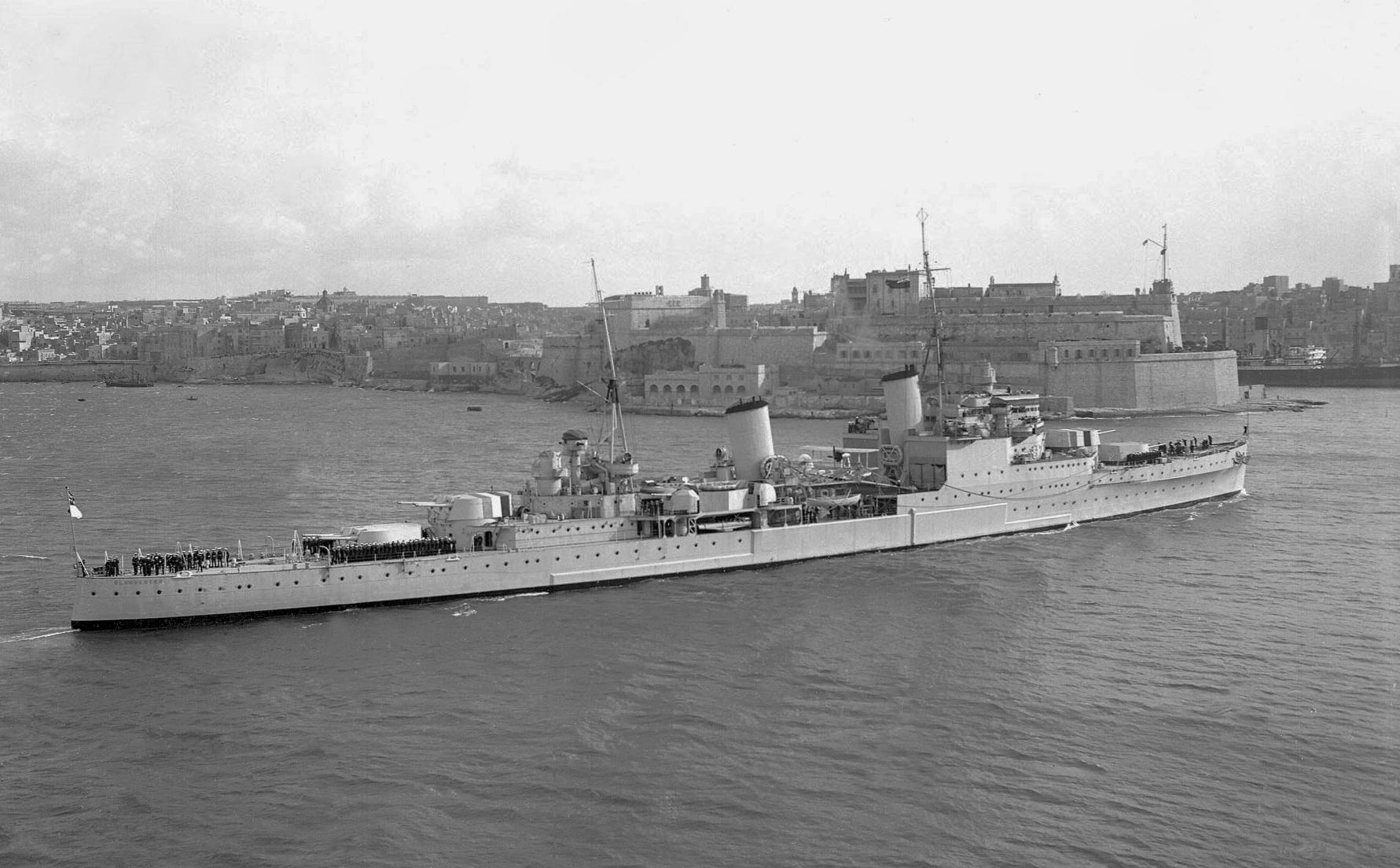
HMS Gloucester (1939) British Light Cruiser
HMS Gloucester (62) was a British light cruiser of the second group of the Town-class cruisers built for the Royal Navy before the Second World War. Nicknamed the “Fighting G,” Gloucester became one of the most active and respected cruisers of the war before her loss in 1941. Designed to protect trade routes and support fleet operations, she combined speed, firepower, and advanced anti-aircraft weaponry, making her an important asset in Britain’s naval war effort.
Built at Devonport Dockyard, Gloucester was launched on 19 October 1937 and commissioned into the Royal Navy in January 1939, only months before the outbreak of war. She displaced about 9,400 tons and could reach speeds of over 32 knots. Her main armament consisted of twelve 6-inch guns mounted in four triple turrets, supported by anti-aircraft guns and torpedo tubes. Like other Town-class cruisers, she was designed for long-range operations and fleet screening duties.
At the beginning of the Second World War, Gloucester served in the Indian Ocean and South Atlantic, where she helped patrol sea lanes and search for German commerce raiders threatening Allied shipping. In 1940 she joined operations in the Mediterranean, a theatre that became central to her wartime service. Gloucester participated in several major naval engagements against the Italian Navy and Axis forces.
One of her most notable actions occurred during the Battle of Cape Matapan in March 1941, one of the most decisive British naval victories in the Mediterranean.
Gloucester was also heavily involved in protecting convoys and supporting Allied troops in Greece and Crete. These operations exposed the ship to constant attack from German aircraft, particularly the Luftwaffe’s dive bombers. Anti-aircraft warfare had become increasingly important by 1941, and cruisers such as Gloucester were frequently called upon to defend larger fleet units and troop convoys.
The cruiser met her fate during the Battle of Crete on 22 May 1941. While attempting to rescue survivors from a British destroyer, Gloucester came under repeated attacks by German Junkers Ju 87 Stuka dive bombers. Critically short of anti-aircraft ammunition after days of continuous fighting, the ship was unable to defend herself effectively. Multiple bomb hits caused severe fires and flooding, and Gloucester eventually capsized and sank south of Crete.
Of her crew of more than 800 officers and sailors, only 85 survived. Many historians later criticised the Admiralty’s handling of the operation, arguing that Gloucester had been placed in an extremely vulnerable position without adequate air cover or ammunition resupply.


