
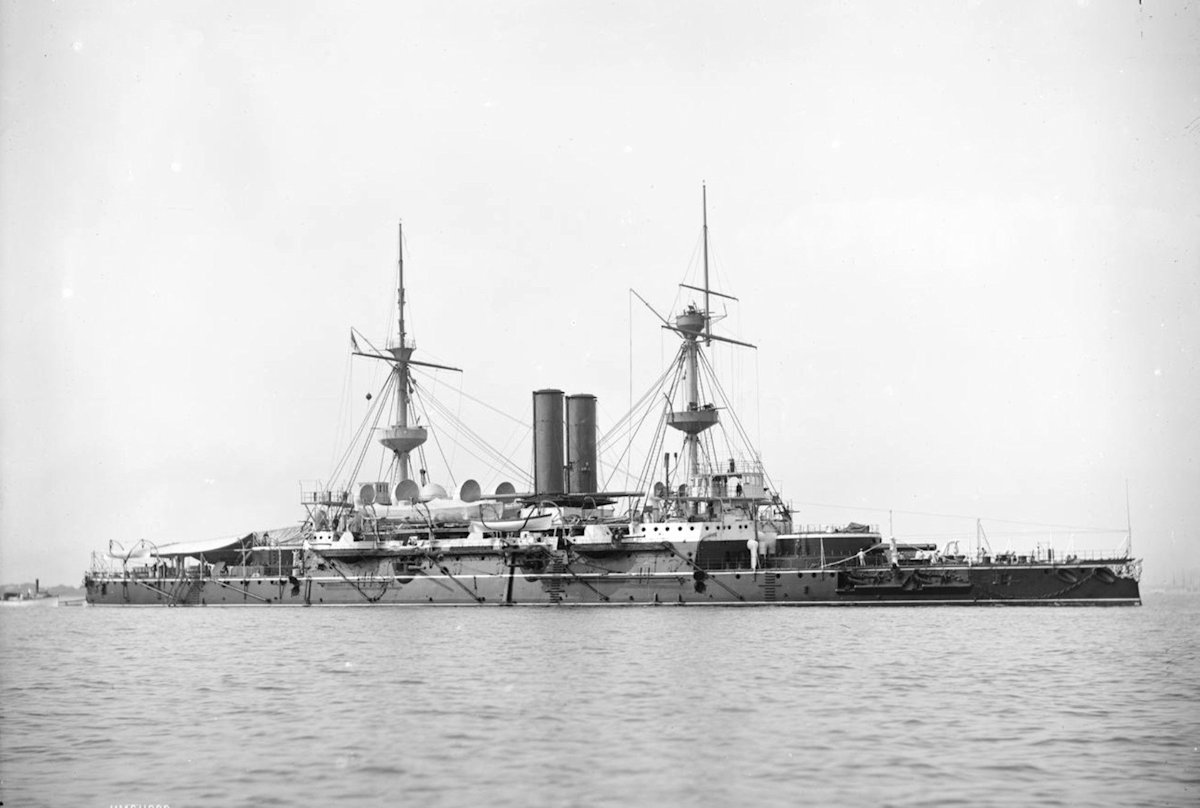
HMS Ramillies (1892)
HMS Ramillies was a Royal Sovereign-class pre-dreadnought battleship of the British Royal Navy, launched on 1 March 1892 at J. & G. Thompson at Clydebank, having been laid down in 1890. She was commissioned into service in 1893.
The Royal Sovereign Class
Ramillies was one of eight ships in the Royal Sovereign class, a landmark group in Victorian naval design. Designed by the Director of Naval Construction Sir William White, these ships represented a significant leap forward from earlier British capital ships. The class introduced high freeboard tumblehome hulls that gave them excellent seakeeping qualities, a marked improvement over the low-freeboard “Admiral” class that preceded them. The other ships of the class included HMS Royal Sovereign, Empress of India, Resolution, Repulse, Revenge, Royal Oak, and Hood.
Design and Specifications
Ramillies displaced approximately 14,150 tons at full load and measured around 410 feet in length with a beam of about 75 feet. She was driven by two triple-expansion steam engines, giving her a top speed of roughly 16–17 knots and a complement of around 700 officers and men.
Her armour was a mix of Harvey and compound steel, with a main belt of up to 18 inches amidships, providing formidable protection for the era.
Armament
Her main battery consisted of four 13.5-inch (343mm) breech-loading guns mounted in two twin barbette turrets, fore and aft. Secondary armament included ten 6-inch (152mm) QF guns, along with smaller quick-firing guns for anti-torpedo-boat defence, and torpedo tubes.
Service History
Ramillies served with the Channel Fleet and later the Mediterranean Fleet during the 1890s, a period when Britain’s naval supremacy under the “two-power standard” (the Royal Navy maintaining a fleet larger than the next two naval powers combined) was in full force. Her active career coincided with the height of the Pax Britannica and the naval rivalry that would eventually lead to the Dreadnought revolution of 1906.
Like the rest of her class, she became increasingly obsolescent as turbine propulsion and the all-big-gun concept emerged in the early 1900s. She was placed in reserve and eventually paid off, being sold for breaking up in 1913, just as HMS Dreadnought had rendered her entire generation of battleships antiquated.


