
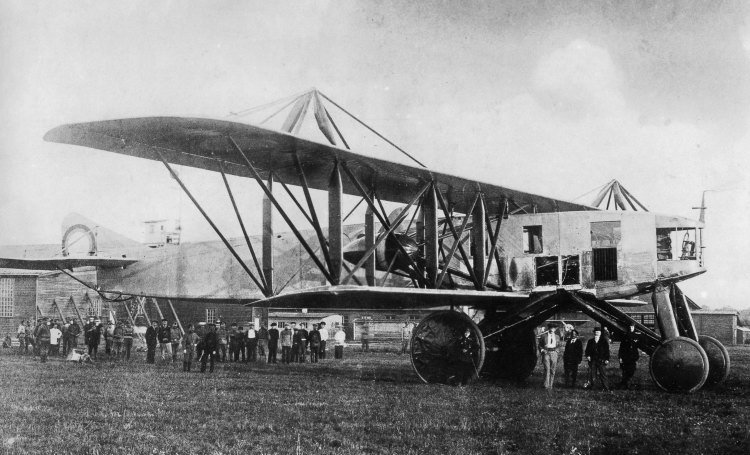
Slesarev Svyatogor
The Svyatogor, designed by Russian engineer Vasily Slesarev, was one of the most ambitious aircraft projects undertaken in the Russian Empire during the First World War. Conceived as a giant long-range bomber, the Svyatogor was intended to be capable of striking deep behind enemy lines.
The aircraft’s name, “Svyatogor,” was drawn from Slavic mythology, referring to a giant warrior, an appropriate designation given the immense scale of the design. At a time when most aircraft were relatively small, lightly constructed biplanes, Slesarev envisioned a machine of extraordinary size and capability. The Svyatogor was intended to surpass the large multi-engine bombers developed by Igor Sikorsky, such as the Ilya Muromets.
Structurally, the Svyatogor was a large biplane with a complex framework designed to support its massive wingspan and weight. It featured a multi-bay wing configuration, with extensive bracing wires and struts to maintain rigidity. The fuselage was similarly robust, designed to accommodate a substantial payload of bombs as well as defensive armament. The aircraft’s size necessitated a large crew, including pilots, gunners, and possibly engineers to monitor systems during flight.
Rather than using a straightforward multi-engine configuration with engines mounted on the wings, the aircraft was designed to use engines housed within the fuselage that drove external propellers via a belt system. This approach was intended to reduce drag and improve aerodynamic efficiency, but it introduced considerable mechanical complexity. At a time when engine reliability was already a major issue in aviation, such a system posed significant engineering challenges.
Construction of the Svyatogor began during the war, but progress was slow due to industrial limitations and the broader strains placed on the Russian economy. Difficulties with the transmission system delayed the project and it was abandoned in 1921 after the death of Slesarev. The Svyatogor never flew.


