
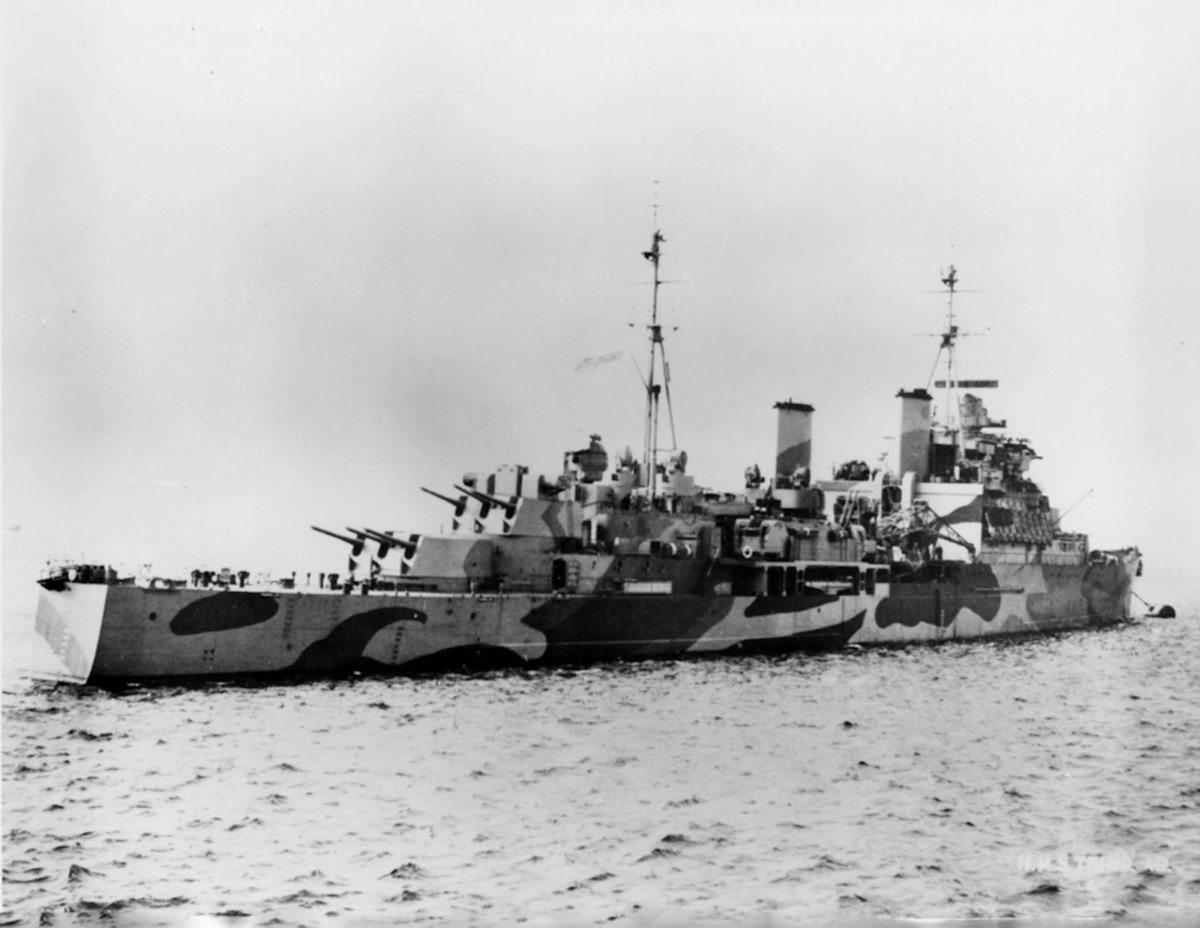
HMS Trinidad (1941) British Light Cruiser
The HMS Trinidad was a British light cruiser of the Royal Navy, built during the late 1930s as part of the Crown Colony or Fiji class. Constructed by Cammell Laird at Birkenhead, she was launched in March 1941 and entered service during one of the most difficult periods of the Second World War. HMS Trinidad was designed to provide strong firepower, speed, and protection while remaining compact enough to meet treaty limitations imposed before the war. Armed with twelve 6-inch guns in four triple turrets, anti-aircraft weapons, and torpedo tubes, she represented an advanced cruiser design for the Royal Navy.
In March 1942, Trinidad took part in the escort of Convoy PQ 13 to northern Russia. During fierce fighting against German destroyers in poor weather conditions, Trinidad engaged enemy ships successfully and helped protect the convoy.
However, during the battle the cruiser suffered one of the most unusual accidents of the war. Trinidad fired a torpedo at a German destroyer, but the torpedo malfunctioned after leaving the tube. Because of extreme cold affecting its steering mechanism, the torpedo curved back toward the cruiser and struck HMS Trinidad herself. The explosion caused severe damage and killed many crew members. Despite the damage, the ship remained afloat and was escorted to the Soviet port of Murmansk for emergency repairs.
After temporary repairs, HMS Trinidad attempted to return to Britain in May 1942. During the voyage she came under repeated attack from German bombers operating from occupied Norway. On 15 May 1942, near Bear Island in the Arctic Ocean, German aircraft scored a bomb hit causing devastating fires and further heavy damage. With the ship crippled and fires out of control, the Royal Navy decided she could not be saved. The following day, Trinidad was abandoned and torpedoed by HMS Matchless and sank in the Arctic Ocean north of North Cape.
Photographs of HMS Trinidad


Refuelling HMS Fury off Iceland in 1942


