
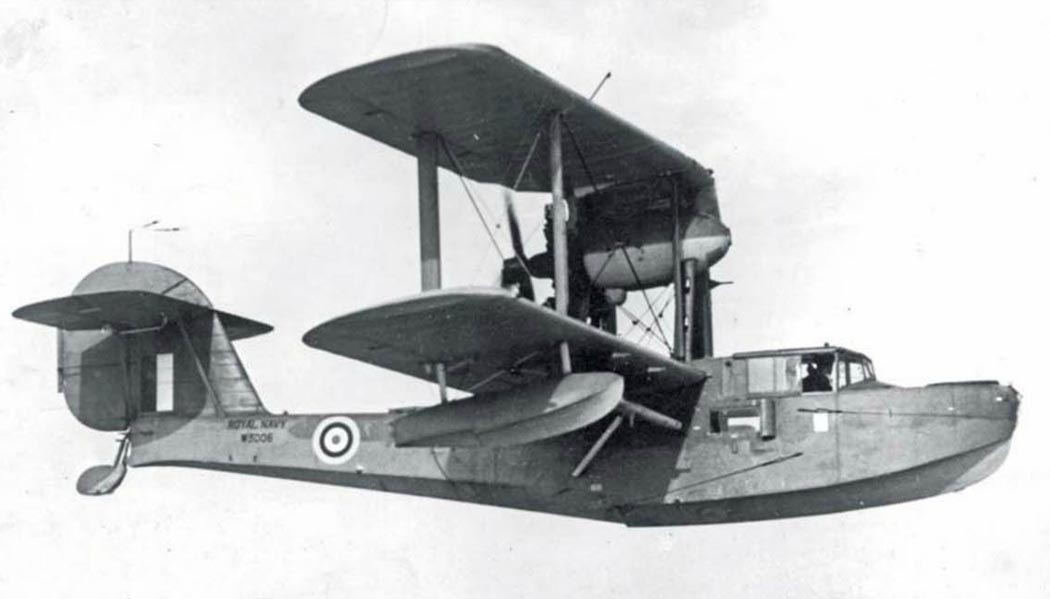
Supermarine Walrus
The Supermarine Walrus was one of the most successful amphibious aircraft of the interwar and Second World War periods. Designed by Reginald Mitchell, the aircraft was developed from the earlier Supermarine Seagull V, a design originally created to meet a requirement from the Royal Australian Navy for a catapult-launched reconnaissance aircraft. The Seagull V proved highly capable, and its success led to its adoption by British forces as the Supermarine Walrus.
The Walrus first flew in June 1933 and was notable for being the first British military aircraft to feature a completely metal hull. It was a single-engine amphibian powered by a Bristol Pegasus radial engine mounted in a pusher configuration between the wings. The aircraft’s retractable landing gear allowed operations from both water and land, while folding wings facilitated storage aboard warships. Typically carrying a crew of three, the Walrus combined rugged construction with excellent seaworthiness, enabling it to operate effectively in challenging maritime conditions.
Entering service with the Fleet Air Arm in 1935, the Walrus quickly became the standard shipborne aircraft of the Royal Navy. Battleships and cruisers carried Walruses for reconnaissance, artillery spotting, and communications duties. Launched by catapult, the aircraft would observe enemy movements and direct naval gunfire by reporting the fall of shot. Its ability to remain airborne at relatively low speeds made it particularly effective in this role.
During the Second World War, the Walrus’s duties expanded considerably. Advances in radar reduced the need for shipborne reconnaissance aircraft, but the Walrus found a vital new role in air-sea rescue. Operated extensively by the Royal Air Force, Walruses patrolled coastal waters searching for downed Allied airmen. Their amphibious capability enabled them to land alongside survivors and recover them directly from the sea, often under hazardous conditions. RAF rescue squadrons credited the type with saving hundreds of lives during the conflict.
The Walrus also undertook anti-submarine patrols, convoy escort, transport, training, and liaison missions. Its rugged nature and dependable performance allowed it to serve in theatres ranging from the North Atlantic and Mediterranean to the Indian and Pacific Oceans. The aircraft’s ability to operate from isolated anchorages and primitive facilities made it invaluable in many remote regions.
Production was shared between Supermarine and Saunders-Roe, with approximately 740 aircraft built. The type served not only with British forces but also with several foreign operators, including Argentina, Australia and New Zealand. Many remained in service after the war, undertaking maritime patrol, training, and rescue duties.
Following military retirement, surplus Walruses found employment in civilian roles, including whaling support, survey work, and commercial transport. Their amphibious capability remained useful in remote coastal regions where conventional aircraft could not easily operate.ce after the war, although some were used for civilian purposes until the 1960s.
Operators
Argentina
The Supermarine Walrus served with the Argentine Naval Aviation (Aviación Naval Argentina) during the 1940s and 50s, providing the navy with a versatile amphibious aircraft capable of operating from both land bases and the sea. Designed by Supermarine Aviation Works, the Walrus was a rugged biplane powered by a Bristol Pegasus radial engine.
Argentina acquired two aircraft in 1940 and a further eight from 1946 to 1950.
One of the most notable aspects of Argentine Walrus service was its operation from the light cruiser La Argentina. The cruiser was equipped with a catapult for launching seaplanes, and the Walrus provided an effective means of extending the ship’s reconnaissance range beyond the horizon. Walrus amphibians in Argentine service operated into the late 1950s.
More here

Australia

Canada
The Royal Canadian Air Force (RCAF) used a small number of Supermarine Walrus amphibians primarily for training and familiarization duties. Several RAF Walruses were stationed in Canada during the war, with approximately eight aircraft serving at various RCAF establishments. These aircraft helped train aircrew in amphibious flying techniques and maritime operations, skills that were important for Canada’s extensive coastal defence and anti-submarine patrol efforts.
Canadian personnel also encountered the Walrus while serving overseas with British units. Many Canadians in the Royal Navy and Royal Canadian Navy served aboard ships equipped with Walrus amphibians. The aircraft’s principal wartime roles included naval reconnaissance, artillery spotting, anti-submarine patrols, communications, and air-sea rescue. By the middle years of the war, advances in radar reduced the need for shipborne spotter aircraft, and many Walruses transitioned to search-and-rescue duties. Across the war, Walrus crews rescued hundreds of Allied airmen who had ditched at sea.
More here

Civil
The Supermarine Walrus also enjoyed a notable post-war civilian career. Its robust construction, amphibious capabilities, and ability to operate from remote waterways made it attractive to a variety of commercial operators and government agencies after military surplus aircraft became available in large numbers following 1945. More here.

Egypt
In September 1945, the Royal Navy officially transferred Walrus W3016 directly to the Egyptian military, where it was re-serialized as N3016. It was utilized primarily for coastal security, maritime reconnaissance, and search-and-rescue (SAR) duties along the Mediterranean coast
France
Following the liberation of France and the rebuilding of French military aviation, the French Navy (Aéronautique Navale) acquired several Walrus aircraft. They were operated mainly by Flottille 53S at the French Naval Aviation School in Hourtin (southwest France) during the late 1940s (around 1945 to 1948).
More here


Ireland
The Supermarine Walrus played a small but interesting role in Irish military aviation during the Second World War, a period known in Ireland as “The Emergency.” The Irish Air Corps operated three Walrus amphibians, acquired from Britain to strengthen the nation’s maritime patrol and air-sea rescue capabilities. Based primarily at Rineanna, the aircraft conducted coastal reconnaissance flights, shipping patrols, and rescue missions around Ireland’s extensive coastline.
Irish Walrus service is particularly remembered for an unusual incident involving aircraft N.18 in January 1942. Four Irish nationals, including an Air Corps pilot, hijacked the aircraft intending to reach German-occupied Europe and join the Luftwaffe. The attempt failed when RAF fighters intercepted the Walrus and forced it to land in Cornwall. Both the aircraft and crew were subsequently returned to Ireland.

New Zealand
The first Walruses associated with New Zealand arrived in 1936–37 aboard the Leander-class cruisers HMS Achilles and HMS Leander. These aircraft were carried on catapults and used for reconnaissance, gunnery spotting, and fleet observation duties. The Walrus was particularly suited to cruiser operations because it could be launched by catapult, land alongside the ship, and then be recovered by crane.
One notable incident occurred on 24 November 1937 in Wellington Harbour when HMS Leander’s Walrus, K8541, overturned while landing after the pilot forgot to retract the undercarriage. Although the crew survived, the aircraft was written off and later replaced by Walrus K8558.
At the outbreak of the Second World War, cruiser-borne Walruses remained part of New Zealand’s naval aviation capability. Achilles landed her aircraft before entering wartime operations, while Leander continued operating a Walrus until 1942. As radar technology improved, the need for ship-launched spotting aircraft declined, leading to the withdrawal of Walrus aircraft from cruiser service.
The RNZAF also operated a small number of Walruses during the latter part of the war. These aircraft were employed primarily for seaplane training and general maritime duties from Hobsonville near Auckland. One example was NZ158 (formerly RAF serial X9512), which arrived at the Seaplane Training Flight in September 1944. The aircraft saw limited use, accumulating only 108 flying hours before being placed in storage after the war ended.
More here

Türkiye
Türkiye became an early export customer for the Supermarine Walrus, procuring six aircraft in 1937 to strengthen its maritime aviation capabilities. Deliveries were completed by April 1938, and the amphibious aircraft entered service with the Turkish military at a time when the nation was modernising its naval and air forces.
In Turkish service, the Walrus was primarily employed for maritime reconnaissance, coastal patrol, navigation training, and communications duties.
Türkiye remained neutral during the Second World War, and consequently its Walrus fleet saw no combat service. Instead, the aircraft spent much of its career conducting routine patrol and surveillance missions, helping to safeguard Turkish territorial waters.
By the mid-1940s, however, the Walrus was becoming outdated and in 1947 they were officially withdrawn from service.

United Kingdom
The Supermarine Walrus was operated by both the Royal Air Force (RAF) and the Royal Navy during the Second World War. Designed by R. J. Mitchell of Supermarine, the amphibious biplane first flew in 1933 and entered British service in 1935. Although originally intended as a fleet reconnaissance and gunnery-spotting aircraft, the Walrus proved adaptable to a wide variety of roles and became an invaluable asset throughout the war. Approximately 740 aircraft were built.
More here

USSR
During the ill-fated PQ 17 convoy (it suffered severe losses to enemy forces) to Russia on July 4, the Walrus from HMS Norfolk was flown off on an ice patrol by Sub Lts Wignall and Riley and Leading Airman Gibbons.
It was eventually towed to Novaya Zemlya and then taken as deck cargo on the SS Ocean Freedom to Archangel
The Supermarine Walrus I flying boat was shipped to Archangel with other supplies brought on the British PQ 17 convoy. British sources believe this plane was scrapped, but in reality it was repaired and supplied to the 16th air transport detachment. This sole Walrus flew to the end of 1943.