
Edo-Tokyo Museum Exhibits Guide: From Edo to Modern Tokyo
The Edo-Tokyo Museum explores the history and culture of Japan’s capital, tracing its development from Edo into modern Tokyo. Opened in 1993, it helps visitors understand how the city and its people have changed over the centuries. Its permanent exhibits combines historical objects, detailed models, and full-scale reconstructions to bring the past to life.
One amazing feature is a life-size reconstruction of Nihonbashi Bridge, which introduces visitors to the exhibition. Displays reveal everyday experiences, including work, trade, entertainment, and domestic life. Miniature cityscapes with outstanding detail recreate the cities’ past.
The museum also examines Tokyo’s transformation through modernization and major challenges.
Getting There
The Edo-Tokyo Museum is in Ryogoku, Tokyo, a short walk from two stations:
- JR Sobu Line: Get off at Ryogoku Station, take the West Exit, and walk approximately 3 minutes to the museum.
- Toei Oedo subway line: Get off at Ryogoku Station, use Exit A3 or A4, and walk approximately 1 minute.
The Displays
The Nihonbashi Bridge Replica
The Nihonbashi Bridge replica acts as the entrance to the main exhibition hall. In old Edo, this bridge served as the official starting point for all five major national highways. From here, you get a great view of the recreated Hattori Clock Tower.

Mid-Jōmon Period Village Model
This model is a replica based on No. 107 site in Tama New Town, situated in Hachiōji City. It represents a traditional circular settlement pattern. The thatched pit-dwellings are arranged in a ring surrounding an open central plaza. It shows how prehistoric Jōmon people lived thousands of years ago in Tokyo’s hilly regions

Terakoya a Private Neighbourhood School
Literally meaning “temple children’s room,” these schools were the pillar of education for commoners during the Edo period (1603–1867). Thanks to the thousands of terakoya operating across towns and villages, Japan achieved remarkably high literacy rates by global standards during this era. Teachers were often educated townspeople, retired samurai, or monks. They were rarely paid in fixed tuition; instead, parents offered gifts or food based on what they could afford.
Rather than rigid testing, education was practical and tailored to what each child would need for their family trade. This primarily focused on reading and writing using specific character manuals and abacus mathematics for commerce.

The Master Craftsman
This life-sized reconstruction portrays the living quarters and workspace of a carpenter, located inside the reconstructed Munewari Nagaya (split row house). During the Edo period, nagaya were long tenement buildings divided into small apartments for the city’s commoners. This exhibit shows a single-room unit that serves as a craftsman’s workshop by day and a family’s domestic living space by night.

Ryōgoku Hirokōj Diorama
One of the best Edo-Tokyo Museum Exhibits is this amazing 1:30 scale diorama represents Ryōgoku Hirokōji (the open plaza) on the west bank approach to the Ryōgoku Bridge, it shows a bustling summer afternoon during the late Edo period (around the mid-19th century).
Following the Great Fire of Meireki in 1657, the Tokugawa shogunate established these hirokōji (literally “wide alleys”) at the foot of major bridges. They were deliberately left free of permanent structures to act as crucial firebreaks to prevent flames from crossing the Sumida River. However, during peacetime, they evolved into the most vibrant entertainment and commercial districts in Edo.
Because permanent buildings were banned, the structures have straw-matting walls and thatched roofs. The towers decorated with geometric patterns and flags are banners signalling active performances. These temporary theatres hosted popular entertainment of the era, including kabuki, puppet plays (joruri), acrobatic feats, and storytelling (rakugo).
If a major fire approached the area, or if the shogunate issued an order, these lightweight bamboo and straw-mat structures could be completely dismantled in a matter of hours.
This entire miniature contains roughly 1,500 hand-painted figures. They have individual expressions, varying clothing styles that distinguish social classes, and even miniature food items inside the stalls.

Ginza Bricktown
This 1:25 scale diorama represents Ginza Bricktown during the early Meiji period. It shows Chuo-dori street shortly after 1877, highlighting the rapid Westernization and modernization of Tokyo. Following a catastrophic fire in February 1872 that completely leveled the wood-and-paper neighborhoods between Ginza and Tsukiji, the Meiji government decided to build a fireproof model city. They hired British architect Thomas James Waters to design a uniform, Western-style commercial district built entirely out of red brick and stone.

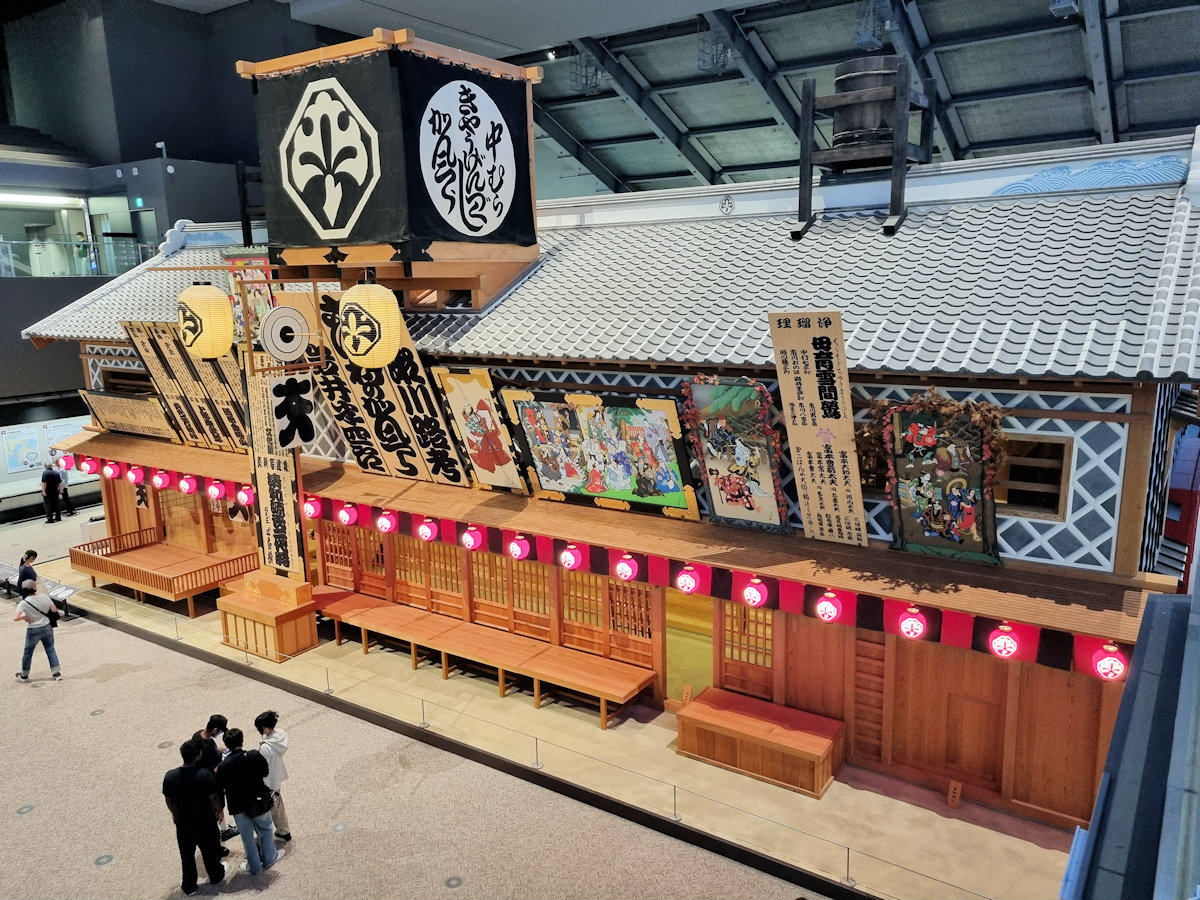
Nakamura-za Kabuki Theatre
This exhibit is a full-scale reconstruction of the Nakamura-za Kabuki Theatre façade.
Rising directly above the main entrance is a wooden tower enveloped in black cloth. This tower holds the theatre’s sacred ginko leaf family crest (kamon) belonging to the founding Nakamura family. In old Edo, a yagura was a government-mandated symbol verifying that a playhouse had formal shogunal approval to run commercial shows

Hattori Watch Store
This life-sized exhibit is the reconstructed façade of the K. Hattori (Hattori Watch Store) building and clock tower. Founded by Kintaro Hattori an entrepreneur who established Seiko, this retail store originally stood at the famous Ginza 4-chome intersection in Tokyo. It symbolizes the rapid Westernization of Japan, capturing the historical shift from traditional seasonal time-keeping to modern, standardized hours.

Dining Kitchen of a 2DK-Type Apartment Unit
This exhibit captures a profound revolution in Japanese domestic lifestyle and residential architecture during the late 1950s and 1960s. Before the post-war era, Japanese homes kept cooking and eating strictly isolated, with families eating on low tables (chabudai) directly on tatami mats. When the Japan Housing Corporation introduced massive public housing complexes known as danchi, they debuted the revolutionary 2DK layout (2 private rooms + a combined Dining/Kitchen area). This single architectural change permanently westernized the daily routine of the average Japanese family.

Entaku (1-Yen Taxi)
During the early Showa period, transportation in Tokyo began to modernise. Taxis like this Ford Model A were nicknamed Entaku because they offered flat-rate rides anywhere within the city limits for exactly one yen.

Living/Dining Room of a Japanese-Western Eclectic House
This room highlights an architectural trend from the Taisho and early Showa eras (1910s–1930s), when middle-class Japanese families began integrating Western layout concepts and furniture with traditional Japanese aesthetics. While the armchairs, dining table, and hanging light fixtures are completely Western-influenced, the room seamlessly transitions into a traditional Japanese tatami room in the back through a set of fusuma (sliding doors) and heavy curtains, ensuring the two distinct cultural aesthetics coexist smoothly without clashing.

Leave a Reply