
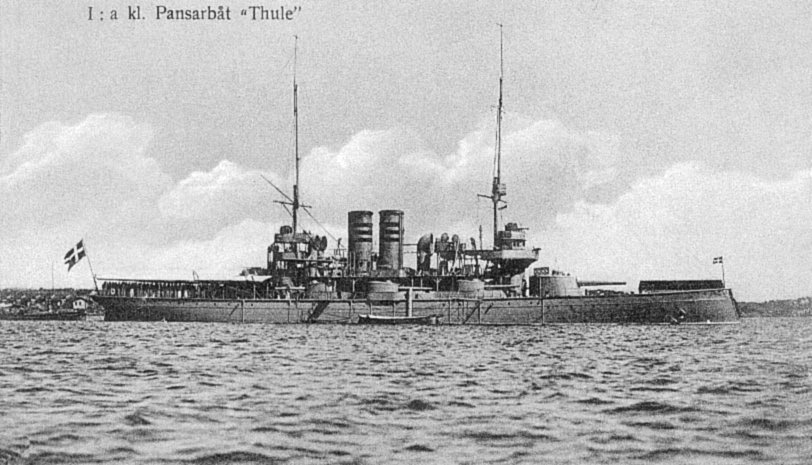
Swedish Navy Coastal Defence Ship HSwMS Thule
HSwMS Thule was a coastal defence ship of the Royal Swedish Navy, commissioned during the late nineteenth century as part of Sweden’s effort to strengthen its coastal forces in the Baltic and surrounding waters. She was launched on 4 March 1893 from the Bergsunds yard in Stockholm, displacing around 3 150 tons with a length of roughly 79.5 m and a beam of 14.6 m. Her propulsion consisted of a two-cylinder steam engine that gave her a top speed of about 16 knots. Her armament as built followed the pattern of the Svea-class coastal defence ships, with heavy guns in twin turrets supported by a secondary battery tailored for defence against smaller craft. The class was intended to operate in the shallow waters of the Swedish littoral and archipelagos, combining heavier armament and armour with the ability to manoeuvre in coastal environments.
Thule’s service career spanned the transition from nineteenth-century pre-dreadnought era naval thinking into the period of the First World War and beyond. She served in the Swedish Navy through neutrality patrols and readiness duties, reflecting Sweden’s strategic focus on defending its own waters rather than projecting power abroad. Like her sisters Svea and Göta, she underwent periodic modernization programmes during her lifetime. These refits typically involved improvements to her artillery, fire control and internal arrangements to keep the aged hull relevant as naval technology evolved around advances in gunnery and propulsion, though detailed records of each modification stage are less complete than those of some later vessels. The modernization efforts kept her operational into the early twentieth century.
By the early 1920s the rapid pace of naval development and the shift in Swedish naval priorities rendered older coastal defence ships like HSwMS Thule increasingly obsolete. She was decommissioned from frontline service in 1923 as newer types and doctrines supplanted the coastal battleship concept developed in the nineteenth century. Following her decommissioning she found a secondary use as an accommodation and utility vessel for a time, before being stricken. After removal from the active list in 1928, she was employed as a target hulk in naval trials and tests, providing a live platform for gunnery and other ordnance practice. Her hull was eventually sold for scrap and broken up in 1933.
References
HSwMS Thule (1893) Wikipedia article.(Wikipedia)
Naval-encyclopedia summary and service details.(naval encyclopedia)


