
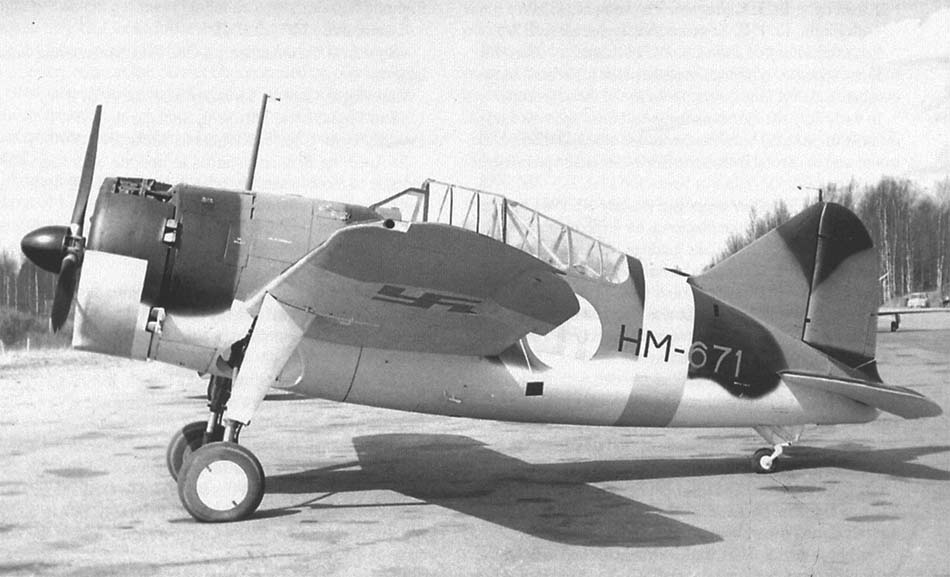
VL Humu Finnish Fighter
The VL Humu was a Finnish attempt to produce a domestically built fighter during the later stages of the Second World War. Developed by the State Aircraft Factory,(Valtion Lentokonetehdas), the design of the Humu was based on the Brewster F2A Buffalo, a type that had achieved notable success in Finnish service despite its poor reputation elsewhere. The Humu was a near-copy of the Buffalo, with only minor modifications to accommodate locally available materials and manufacturing processes.
Work on the prototype began in 1942, at a time when Finland faced increasing difficulty importing aircraft and spare parts due to the shifting dynamics of the war. The intention was to create a fighter that could be produced domestically using largely non-strategic materials. As a result, the Humu incorporated a significant amount of wood in its construction, particularly in the wings and rear fuselage. While this approach conserved scarce metals such as aluminium, it also introduced structural and performance limitations that would prove difficult to overcome.
It was powered by a licence-built version of the Wright R-1820 Cyclone radial engine, which had also powered the original Buffalo.
The prototype Humu first flew in 1944. By this stage of the war, however, the design was already obsolete. Fighter aircraft development had advanced rapidly, and the Humu’s performance was markedly inferior to that of modern Soviet and German fighters then in service. Flight testing revealed that the aircraft suffered from poor handling characteristics, excessive weight, and disappointing speed and climb performance. The substitution of wood for metal had increased the airframe weight beyond acceptable limits, negating any aerodynamic advantages inherited from the Buffalo design.
Only a single prototype was completed, and no production order followed. The Humu project was effectively abandoned soon after its initial evaluation.


