
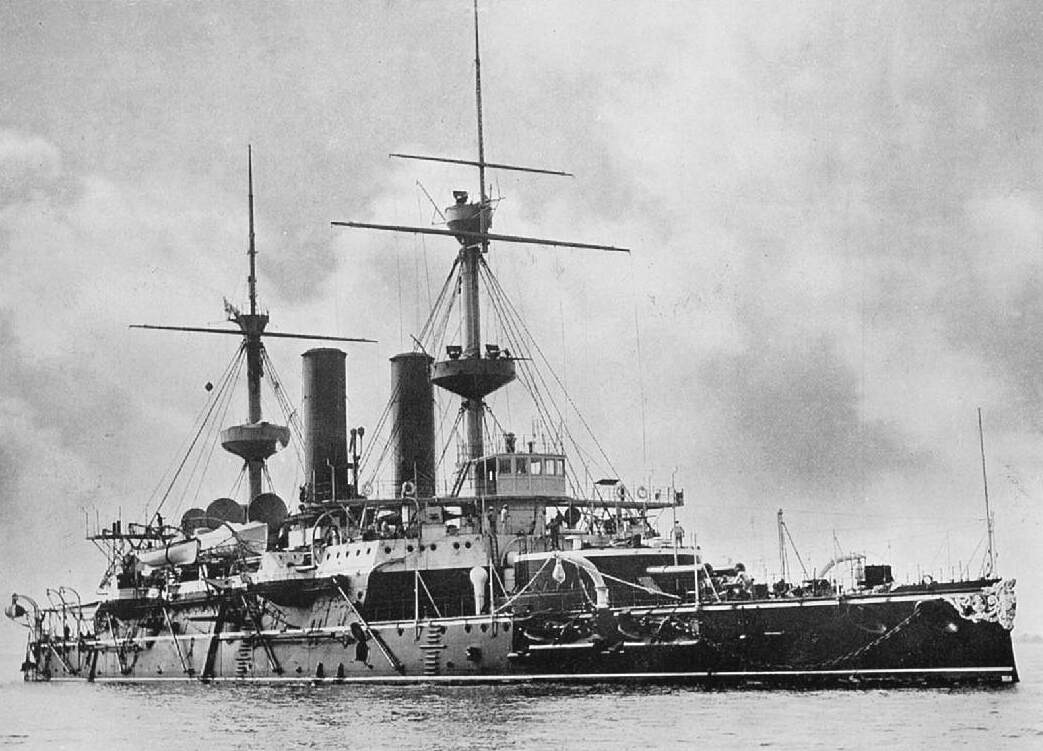
HMS Hood (1891)
HMS Hood was a British Royal Navy pre-dreadnought battleship of the Royal Sovereign class, though significantly modified from her sisters.
Design & Construction
Hood was laid down in 1889 at Chatham Dockyard and launched on 30 June 1891. She was designed by the Director of Naval Construction, Sir William White, and was intended to serve as a low-freeboard battleship, which distinguished her fundamentally from the high-freeboard Royal Sovereign sisters. The low freeboard was caused by the use of turrets to mount her main armament. Her sisters all used open topped barbettes. This design choice increased her displacement, so that she sat much lower in the water, making her a smaller target but also far less seaworthy in rough conditions.
Her displacement was approximately 14,780 tons, and she measured around 410 feet in length.
Armament
Hood carried a main battery of four 13.5-inch guns mounted in two twin turrets, fore and aft. Her secondary armament included a number of quick-firing guns for defence against torpedo boats. She also carried torpedo tubes, consistent with capital ship practice of the era.
Propulsion & Performance
She was powered by two sets of triple-expansion steam engines driving twin screws, giving her a top speed of around 17.5 knots. Her low-freeboard design, however, meant she was notoriously wet at sea and not well-suited to extended blue-water operations.
Service History
Hood‘s active service career was relatively uneventful. She served with the Channel Squadron and later the Mediterranean Fleet, but her low-freeboard configuration meant she was of limited strategic utility compared to her more seaworthy sisters.
On 4 November 1914, early in the First World War, when she was deliberately sunk as a blockship in the southern entrance of Portland Harbour to protect the anchorage from submarine attack.


