
Surviving Australia Exhibition at the Australian Museum
The Surviving Australia exhibition at the Australian Museum explores the extraordinary wildlife that has evolved across Australia’s diverse and often challenging environments. Located on Level 2, this permanent exhibition combines fossils, life-sized animal models, interactive displays and scientific research to reveal how Australian species have adapted to survive.
Reopened on 15 December 2025 following a major redevelopment, the exhibition occupies approximately 600 square metres.
Prehistoric Australia
One of the exhibition’s highlights is its collection of prehistoric megafauna. Life-sized reconstructions let you see the real size of these creatures, including Diprotodon, a giant wombat-like marsupial that once inhabited Australia. Other displays feature ancient kangaroos, unusual monotremes and prehistoric predators. These exhibits explain how Australia’s geographical isolation encouraged the evolution of distinctive animals found nowhere else.
Australia’s Diverse Environments
The exhibition explores several major Australian habitats, including tropical rainforests, eucalypt forests, deserts, coastal waters and marine ecosystems. Displays demonstrate how animals survive extreme temperatures, drought, bushfires and dangerous predators. The species range from kangaroos and cassowaries to sharks, snakes and spiders.
There are interactive exhibits that explain the physical and behavioural adaptations that allow these creatures to flourish.
Conservation and Human Impact
Another important theme examines the challenges facing Australia’s wildlife today. Habitat destruction, urban development, introduced species and climate change threaten many native animals. The exhibition also highlights aboriginal environmental knowledge, including traditional cultural burning practices that help maintain healthy ecosystems.
Visiting Surviving Australia
Entry is free. Its central Sydney location, opposite Hyde Park, makes the exhibition very easy to get to.
For further information, visit the official Surviving Australia exhibition page.
Thylacoleo carnifex (Marsupial Lion)
Thylacoleo carnifex, commonly known as the marsupial lion, was one of the most formidable predators of prehistoric Australia. Living during the Pleistocene, this powerful carnivorous marsupial became extinct approximately 40,000 years ago. Despite its name, it was not related to true lions but belonged to a unique lineage of Australian marsupials. Its massive jaws, exceptionally sharp slicing premolars and powerful forelimbs made it a highly specialised predator. Large, retractable claws probably helped it capture and restrain prey. Fossil discoveries suggest Thylacoleo hunted substantial animals, potentially including young megafauna.

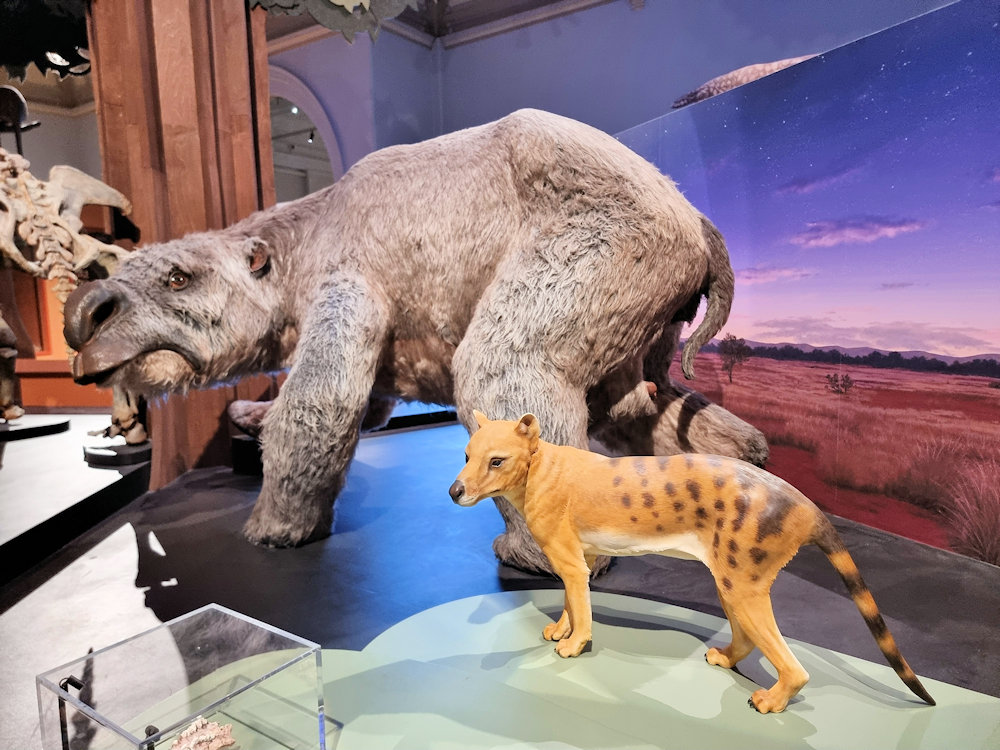
Diprotodon and Thylacine
This display features two extinct Australian animals. The enormous grey animal is a reconstruction of Diprotodon, the largest known marsupial, which lived during the Pleistocene. Resembling a gigantic wombat, Diprotodon was a herbivore that inhabited Australia’s forests, woodlands and grasslands. In front stands a reconstruction of the thylacine (Thylacinus cynocephalus), commonly known as the Tasmanian tiger. Its striped hindquarters and long tail are distinctive. The last known captive thylacine died in Hobart Zoo in 1936.


Ekaltadeta ima (Giant Carnivorous Rat-Kangaroo)
Ekaltadeta ima, is an extinct carnivorous marsupial that inhabited Australia approximately 25 million years ago. Sometimes called the giant rat-kangaroo or killer kangaroo, it belonged to an unusual group of prehistoric kangaroo relatives. Fossils discovered at Riversleigh in north-western Queensland reveal powerful jaws and specialised blade-like premolars capable of slicing through flesh. Unlike modern herbivorous kangaroos, Ekaltadeta ima probably consumed meat, although its precise diet remains uncertain.

Giant Short-faced Kangaroo
The extinct giant short-faced kangaroo, Procoptodon goliah, was one of the largest kangaroos to inhabit Australia. Unlike modern kangaroos, it possessed a relatively short face, powerful arms, long claws and a single large toe on each foot. It could weigh more than 250 kilograms and probably moved by walking upright rather than hopping.

Monitor Lizard on a Termite Mound

Emu and Chicks
Emus (Dromaius novaehollandiae) are Australia’s largest native birds and the world’s second-largest living birds after ostriches. Male emus undertake the responsibility of incubating their eggs for approximately eight weeks and subsequently caring for their young. The chicks’ distinctive brown and cream stripes provide camouflage against vegetation and the surrounding landscape.

Budgerigars in Their Natural Habitat

Murrayglossus hacketti (Hackett’s Giant Echidna)
Murrayglossus hacketti, is an extinct giant echidna that inhabited Western Australia during the Pleistocene epoch. Considered the largest egg-laying mammal ever discovered, this monotreme could reach approximately one metre in length and weigh up to 30 kilograms. Its powerful limbs, substantial claws and elongated snout show adaptations for digging and searching for food. Scientists believe it may have specialised in feeding on termites, although its precise diet remains uncertain.

Australian Cicadas
This photo shows two cicada specimens, including a double drummer cicada with its wings extended to reveal intricate orange veins and a smaller black prince cicada. Cicadas are well known for their loud summer calls, produced by specialised structures called tymbals in males. They spend much of their lives underground as nymphs, feeding on fluids from plant roots before emerging as adults. Australia’s cicadas vary enormously in size, colour and sound, with many species adapted to different habitats and climatic conditions.

Meiolania, the Giant Horned Turtle
This life-sized reconstruction depicts Meiolania, an extinct giant horned turtle that once inhabited Australia and nearby islands. Unlike modern turtles, Meiolania possessed a heavily armoured head with prominent horns and a long, spiked tail. These defensive adaptations helped protect it from predators. Some species reached approximately 2.5 metres in total length.

Other Places to Visit in New South Wales
To see what else there is to do in New South Wales, click here.
Leave a Reply