
Takayama Jinya Historic Government Office
Takayama Jinya is a well-preserved historic government office in Takayama, Gifu Prefecture. Originally established as the residence of the Kanamori clan, it became a government office in 1692 when the Tokugawa Shogunate placed Hida Province under its direct control.
For nearly two centuries, Takayama Jinya served as the administrative centre for the region. Government officials oversaw taxation, legal proceedings, policing and the management of local resources, particularly timber and rice. Remarkably, it is the only surviving main building of an Edo-period provincial government headquarters of its kind in Japan.
Visitors can explore the traditional wooden buildings, tatami-matted offices, reception rooms and residential quarters. The complex also includes an interrogation room and a large rice storehouse, where taxes paid in rice were kept. Exhibits of historical documents, agricultural equipment and everyday objects help explain life under the Shogunate.
Takayama Jinya remained in government use until 1969. Following extensive restoration, it reopened as a historical museum, preserving an important part of Japan’s administrative history. It provides an opportunity to explore an authentic Edo-period government complex and understand how the region was governed.
Government Office (Goyakusho)
The Goyakusho, or government office is a large tatami-matted room used for official administrative work during the Edo period. Low writing desks, document boxes and other furnishings illustrate the working environment of government officials. Sliding fusuma doors divide the interior, while exposed timber beams and a wooden ceiling demonstrate traditional Japanese architectural techniques. During the Edo period, officials working here handled administrative matters, including taxation, public affairs and correspondence.


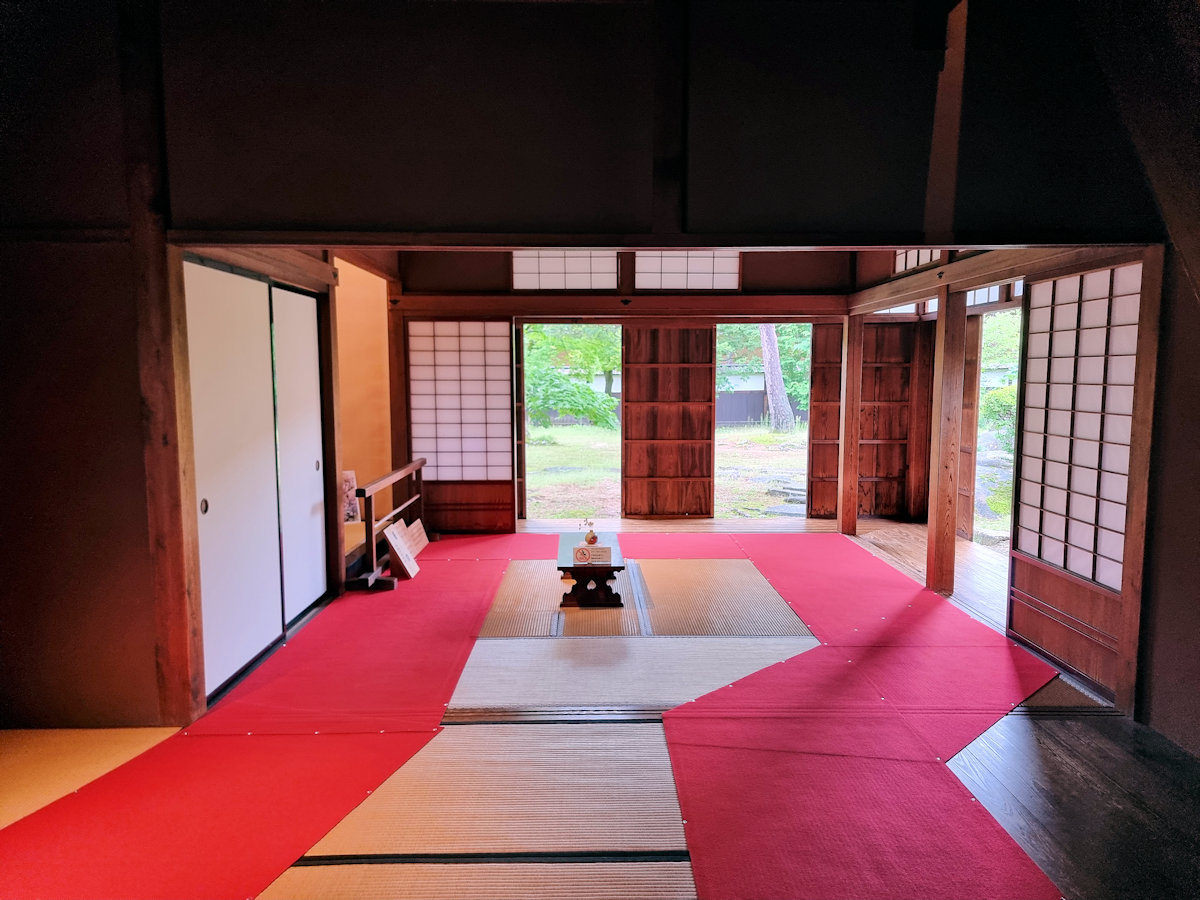
Traditional Reception Room and Garden
This spacious traditional Japanese room features tatami flooring, timber pillars, sliding shoji screens and wooden storm shutters. The open doors provide views of the surrounding garden, demonstrating the connection between traditional Japanese architecture and nature. The red protective carpet marks the visitor route through the historic building. Rooms such as this formed part of the government complex, which included official reception areas, meeting rooms and residential quarters for the magistrate and his household.

Traditional Forestry and Woodcutting Tools
This display of traditional Japanese forestry tools, includes axes, adzes, sickle-shaped cutting implements and other woodworking equipment. The illustrated panels explain the methods used to fell trees, prepare timber and process wood by hand. Forestry was particularly important in Hida Province, whose valuable timber resources were one reason the Tokugawa Shogunate brought the region under direct control in 1692.

Rice Bales in the Storehouse
These stacks of tightly bound straw bales represent the rice collected as taxation during the Edo period. Rice was an important measure of wealth and a major source of government revenue. Takayama Jinya’s Onkura rice storehouse was used to hold rice collected from villages throughout Hida Province. The surviving storehouse dates from the early seventeenth century and was relocated from Takayama Castle in 1695. It now forms part of the museum explaining the region’s taxation system and agricultural history.

Samurai Armour Display
This armour includes a helmet (kabuto) with a prominent crest, protective shoulder guards, a plated cuirass and armoured sleeves. Behind the figure are several long, narrow banners or standards.

Bronze Statue of Yamaoka Tesshū in His Youth
Located outside Takayama Jinya is a bronze statue titled Blue Clouds Yamaoka Tesshū in His Youth. Yamaoka Tesshū (1836–1888) was a prominent samurai and statesman who spent part of his childhood in Takayama. He later played an important role in Japan’s transition from the Tokugawa Shogunate to the Meiji government.

To find out more about Japan, see our blogs here
Leave a Reply