
Hiroshima Peace Memorial Park
Hiroshima Peace Memorial Park is one of Japan’s most important historical sites. Located in central Hiroshima, the park commemorates the victims of the atomic bombing on 6 August 1945. It serves as a place of remembrance and promotes the importance of world peace and nuclear disarmament.
At 8:15 am on 6 August 1945, an American B-29 bomber, Enola Gay, dropped the atomic bomb known as Little Boy over Hiroshima. The explosion devastated much of the city, killing tens of thousands of people immediately. By the end of 1945, approximately 140,000 people had died from the bombing and its effects.
Before the bombing, the area contained a busy commercial and residential district. Following the war, Hiroshima transformed the devastated neighbourhood into Peace Memorial Park. Japanese architect Kenzō Tange designed the park, which opened in 1954.
Getting There from Hiroshima Station
The easiest way to reach Hiroshima Peace Memorial Park is by tram.
- From Hiroshima Station, take Hiroshima Electric Railway (Hiroden) tram Line 2 towards Miyajimaguchi or Line 6 towards Eba.
- Get off at Genbaku Dome-mae (Atomic Bomb Dome) after approximately 20 minutes.
- Walk across the nearby bridge to enter Peace Memorial Park.
- Alternatively, take the Meipuru-pu Hiroshima Sightseeing Loop Bus, which also serves the park.
Allow approximately two to three hours to explore the monuments and museum. Entry to the park is free, although the museum charges an admission fee.
Main Attractions
Peace Bell – Hiroshima Peace Memorial Park
The Peace Bell in Hiroshima Peace Memorial Park symbolises the hope for lasting world peace and the abolition of nuclear weapons. Installed in 1964, the large bronze bell hangs beneath a concrete dome supported by four pillars.
The bell features an image of a world map without national borders, representing a united humanity. Its striking surface displays an atomic symbol, reminding people of the dangers of nuclear weapons.
You are allowed (and actually encouraged) to ring the bell, sending a message of peace across the park.

Cenotaph for the A-bomb Victims
The Cenotaph for the A-bomb Victims stands at the centre of Hiroshima Peace Memorial Park. Unveiled on 6 August 1952, the monument honours those who died following the atomic bombing of Hiroshima.
Designed by architect Kenzo Tange, its arch represents an ancient Japanese house, offering symbolic shelter to the victims’ souls. Beneath the arch rests a stone chest containing a register of the names of those who died from the bombing. An inscription reads, “Let all the souls here rest in peace, for we shall not repeat the evil.”
The cenotaph aligns with the Peace Flame and Atomic Bomb Dome.

Atomic Bomb Dome
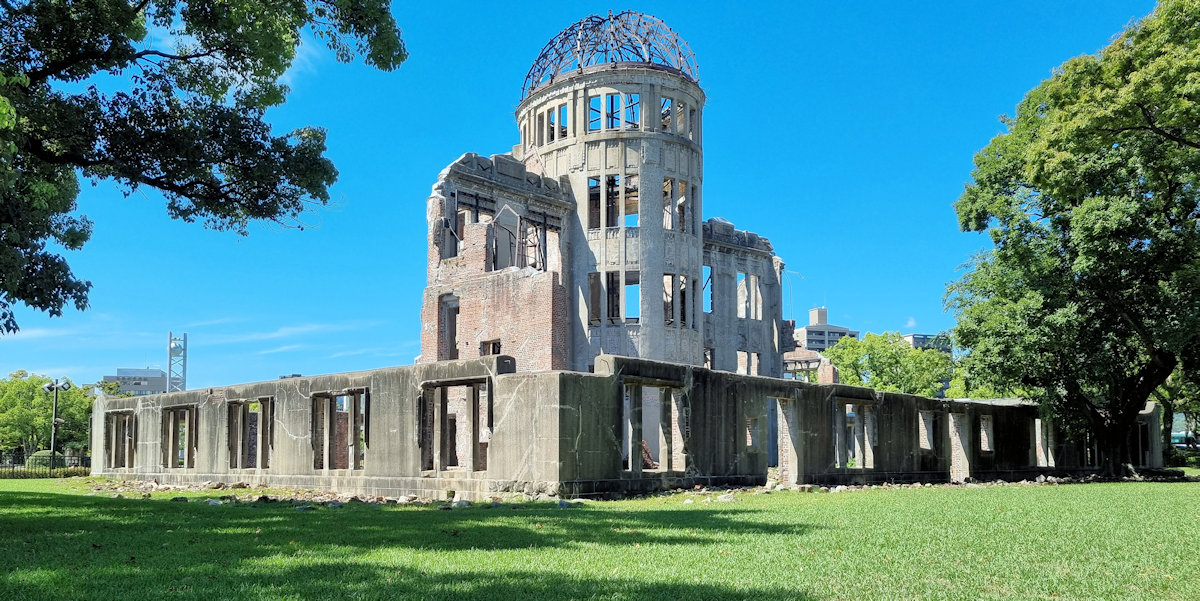
The Atomic Bomb Dome is one of Hiroshima’s most recognisable landmarks and a powerful reminder of the atomic bombing on 6 August 1945. Originally completed in 1915, the building served as the Hiroshima Prefectural Industrial Promotion Hall. It stood approximately 160 metres from the bomb’s hypocentre and suffered extensive destruction. Remarkably, parts of its walls and distinctive steel dome survived the explosion, although everyone inside died.
Today, the ruins serve as a memorial to the victims and a warning against nuclear warfare. UNESCO designated the Atomic Bomb Dome a World Heritage Site in 1996, recognising its historical significance.
For a bird’s eye-view of the dome, go to the top of the Hiroshima Orizuru Tower. It has an observation deck that lets you look over the city and Peace Memorial Park. Opening hours are 10:)) am to 6:00 pm with an entry fee of ¥2,200 (September 2026).


observation deck
Korean Atomic Bomb Victims Cenotaph
The Korean Atomic Bomb Victims Cenotaph commemorates the thousands of Koreans who died during the atomic bombing of Hiroshima on 6 August 1945. Many Koreans lived in Hiroshima during the Second World War, including those brought to Japan as forced labourers under Japanese colonial rule. Unveiled in 1970, the monument originally stood outside the Peace Memorial Park. Authorities relocated it inside the park in 1999.
The memorial features a stone turtle supporting a tall monument crowned by a dragon, reflecting traditional Korean symbolism. The cenotaph honours Korean victims and highlights their suffering under Japanese occupation and during the atomic bombing.

Atomic Bomb Memorial Mound
The Atomic Bomb Memorial Mound in Hiroshima Peace Memorial Park contains the ashes of approximately 70,000 victims of the atomic bombing on 6 August 1945. Following the explosion, authorities cremated many unidentified victims and buried their remains at this location. The mound also holds ashes of people whose families could not be located.
Established in 1946, the memorial features a large, grass-covered mound with a stone chamber beneath it.

Hiroshima Peace Memorial Museum
The Hiroshima Peace Memorial Museum documents the devastating atomic bombing of Hiroshima on 6 August 1945 and its lasting impact on the city and its people. Opened in 1955, the museum stands within Hiroshima Peace Memorial Park. Its exhibitions explain the events leading to the bombing, the destruction it caused and the suffering experienced by survivors.
Among the displays are damaged clothing, personal belongings, photographs and everyday objects recovered from the ruins. These items tell the stories of individuals who lost their lives or suffered terrible injuries. The museum also examines the effects of radiation, including the long-term health problems experienced by survivors, known as hibakusha.
Additionally, exhibits explore the development of nuclear weapons and international efforts towards nuclear disarmament. Some displays are confronting, particularly those showing the injuries suffered by victims. However, the museum provides an important understanding of the bombing’s human cost and promotes the importance of lasting world peace.


To find out more about Japan, see our blogs here


Leave a Reply