
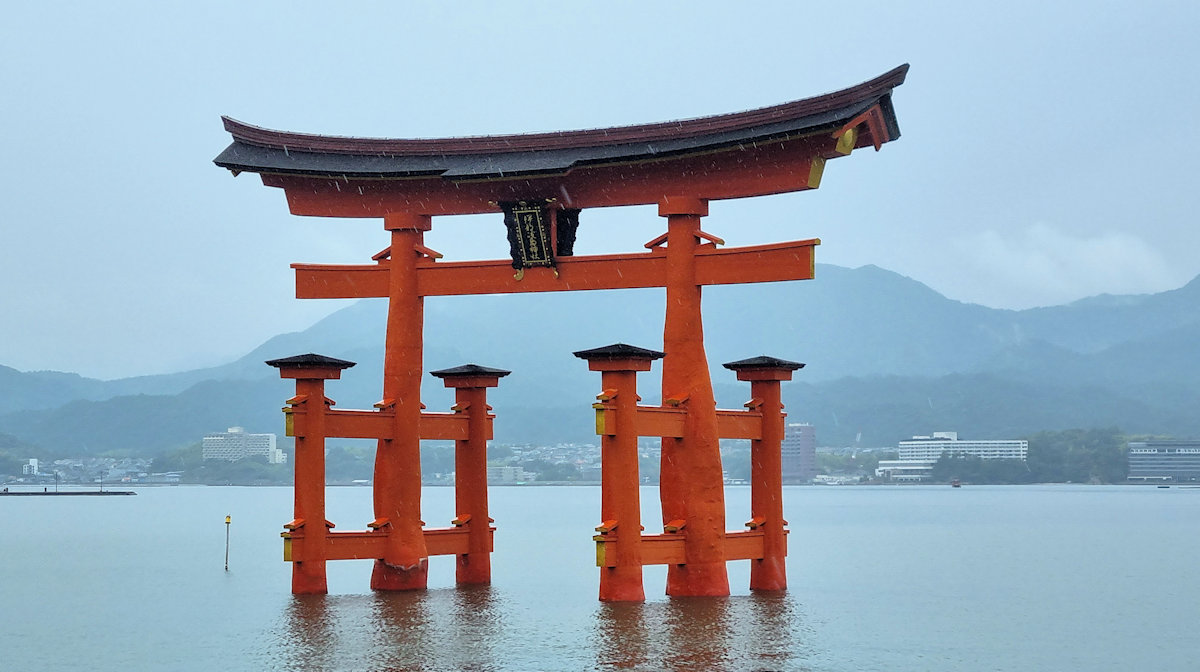
Miyajima Island
Miyajima Island, officially known as Itsukushima, is one of Japan’s most beautiful and historically significant destinations. Located in Hiroshima Bay, the island combines ancient shrines, traditional streets, forested mountains and magnificent coastal scenery.
The island’s most famous landmark is Itsukushima Shrine, a UNESCO World Heritage Site since 1996. Originally founded in 593, the shrine gained much of its present appearance during the twelfth century. Its vermilion buildings stand on stilts above the water, creating the impression that they float during high tide.
Nearby, the enormous red Otorii Gate stands in the sea. At high tide, water surrounds its foundations. However, at low tide, you can walk across the exposed seabed and approach the gate.
Beyond the shrine, Miyajima offers several other attractions. The five-storey pagoda overlooks the historic town, while Daisho-in Temple features Buddhist statues, prayer halls and peaceful gardens.
For panoramic views, you can take the Miyajima Ropeway towards Mount Misen. Walking trails lead through the surrounding forest to the summit.
Meanwhile, the island’s shopping streets contain souvenir shops, restaurants and traditional buildings. You can also try local specialities, including grilled oysters and momiji manju, maple-leaf-shaped cakes filled with sweet bean paste.
Another attraction is the population of wild deer that wander through the town and surrounding areas.
Getting to Miyajima from Hiroshima
From Hiroshima Station, take the JR Sanyo Line towards Iwakuni and get off at Miyajimaguchi Station. The journey takes approximately 30 minutes.
Next, walk to Miyajimaguchi Ferry Terminal and board either the JR Miyajima Ferry or Miyajima Matsudai Kisen ferry. The crossing takes approximately 10 minutes, and you get excellent views of the island and its torii gate. The cost was ¥200 each way in September 2026 and you can use your PASMO card.
Taira no Kiyomori
Sitting near the water front not far from the ferry terminal is a bronze statue of Taira no Kiyomori (1118–1181). He was a powerful military leader who transformed Itsukushima Shrine during the 12th century. Dressed in traditional robes, he holds a ceremonial fan and Buddhist prayer beads. As head of the influential Taira clan, he rose to become one of Japan’s most powerful political figures during the late Heian period.
Kiyomori developed a strong devotion to Itsukushima Shrine, which honours three Shinto goddesses associated with the sea. In 1168, he sponsored an extensive reconstruction of the shrine, creating much of the distinctive architectural style seen today. Under his patronage, Itsukushima Shrine gained its famous interconnected buildings and corridors extending over the tidal waters. The design reflected the belief that Miyajima Island was a sacred island where the gods resided.
Kiyomori also encouraged members of the imperial court to visit the shrine, increasing its religious and political importance.

Itsukushima Shrine on Miyajima Island
Itsukushima Shrine is one of Japan’s most famous Shinto shrines. Its distinctive vermilion buildings and floating torii gate make it one of the country’s most recognisable landmarks. Although the shrine’s origins date to 593, much of its present architectural style developed under the patronage of Taira no Kiyomori in 1168. The shrine honours three Shinto goddesses associated with the sea, navigation and maritime protection.
Itsukushima Shrine features interconnected wooden corridors, prayer halls and ceremonial buildings supported by pillars above the tidal flats. At high tide, the structures appear to float on the water. However, at low tide, you can walk across the exposed seabed towards the famous Great Torii Gate. The shrine became a UNESCO World Heritage Site in 1996, recognising its historical, cultural and architectural importance.


Daishō-in Temple
Daishō-in Temple is one of Miyajima’s most important Buddhist temples, located at the foot of Mount Misen. Founded in 806 by the monk Kūkai, the temple belongs to the Shingon school of Japanese Buddhism.
The temple complex has numerous prayer halls, Buddhist statues, pagodas and gardens. One of its most popular attractions is the path lined with 500 Rakan statues, representing enlightened disciples of Buddha. Each statue has a different expression, while many wear colourful knitted caps.
Another highlight is Henjokutsu Cave, where hundreds of illuminated lanterns hang above 88 Buddhist statues representing the famous Shikoku Pilgrimage.
The temple also houses an impressive collection of Buddhist artwork, including a golden Miroku Bosatsu statue and a reclining Buddha.
Niōmon Gate
The entrance gate to Daishō-in Temple stands beneath a traditional tiled roof. Two wooden Niō guardian statues occupy alcoves on either side of the entrance. These fierce Buddhist guardians symbolically protect the temple from evil influences. A stone staircase continues uphill through the gateway towards the temple complex. As you walk uphill to the temple, you pass prayer wheels. You can spin these as you pass.

A stone statue depicting a tengu, a supernatural figure from Japanese folklore stands near the steps leading up to the temple. Tengu are associated with mountains, forests and spiritual traditions.


Five Hundred Rakan Statues
The Five Hundred Rakan Statues line a stone pathway at Daishō-in Temple. These statues represent enlightened disciples of Buddha who achieved spiritual wisdom through his teachings. Each statue has a unique facial expression, posture and personality. Some appear cheerful, while others look thoughtful, serious or peaceful. Many wear colourful knitted caps, donated by worshippers and locals as offerings of respect and devotion.


Jizō Bodhisattva Statues
Jizō Bodhisattva statues are a common sight at Daishō-in Temple. In Japanese Buddhism, Jizō is a compassionate guardian who protects children, travellers and souls in the afterlife.
The statues often depict a Buddhist monk holding a staff and a wish-fulfilling jewel. Many wear red knitted caps or bibs, donated by worshippers seeking protection, good fortune or blessings for departed loved ones. You will find Jizō statues appear beside pathways, staircases and prayer halls throughout Daishō-in Temple.


Henjokutsu Cave
Inside Henjokutsu Cave at Daishō-in Temple, rows of illuminated lanterns hang above stone Buddhist statues. The cave contains 88 sacred images representing the temples of the famous Shikoku Pilgrimage. Beneath the floor tiles in front of each statue lies sand collected from the corresponding Shikoku temple. According to Buddhist tradition, walking over this sand offers the same spiritual blessings as completing the 1,200-kilometre pilgrimage.


Reclining Buddha
The Reclining Buddha represents Shakyamuni Buddha entering Nirvana at the end of his earthly life. Located in Shaka Nehan Hall, the life-sized golden statue depicts Buddha resting peacefully on his side. Sixteen disciples surround the reclining figure, symbolising those who witnessed his final moments and teachings. In Buddhism, this scene represents Parinirvana, the state of complete liberation from suffering and the cycle of rebirth.

Kongō-Yasha Myōō
Kongō-Yasha Myōō is one of the Five Wisdom Kings of Japanese Esoteric Buddhism. His statue stands in the northern corner of Chokugandō Hall. Known as the Vajra Yaksha Wisdom King, he represents the power to overcome evil, destroy ignorance and protect Buddhist teachings. He is traditionally depicted with three faces, six arms and a fierce expression, symbolising his determination to defeat negative forces.

Maitreya Bodhisattva
Maitreya Bodhisattva, known in Japan as Miroku Bosatsu, represents the future Buddha who will appear on Earth to spread Buddhist teachings and guide humanity towards enlightenment. At Daishō-in Temple, a golden statue of Maitreya stands inside the Miroku Room of Kannondo Hall. Colourful Tibetan decorations surround the figure, reflecting the temple’s connections with Tibetan Buddhism. In 2006, the Dalai Lama consecrated the statue during a visit celebrating the temple’s 1,200-year history.

Stairway leading up to the Nature Walk and Tahoto Pagoda

Tahōtō Pagoda
Tahōtō Pagoda is a historic two-storey Buddhist pagoda overlooking Itsukushima Shrine. Built in 1523 by the monk Shukan, the 15.6-metre-tall structure combines traditional Japanese architecture with Chinese and Indian influences.
Originally dedicated to Yakushi Nyorai, the Buddha of Medicine, its sacred statue moved to Daiganji Temple during the Meiji Restoration.
The site offers excellent views across Miyajima Island and Hiroshima Bay.


Traditional Buildings on Miyajima Island
The main street has some great traditional buildings.

Traditional Shishimai Lion Dance Mask

Sika Deer
These free-roaming deer are found all over the island. You will run into them frequently around shops, temples and public spaces. Remember that they are wild animals, and will eat things you might be holding. Warning signs say to keep tickets, maps and souvenirs away from them.

To find out more about Japan, see our blogs here


Leave a Reply