
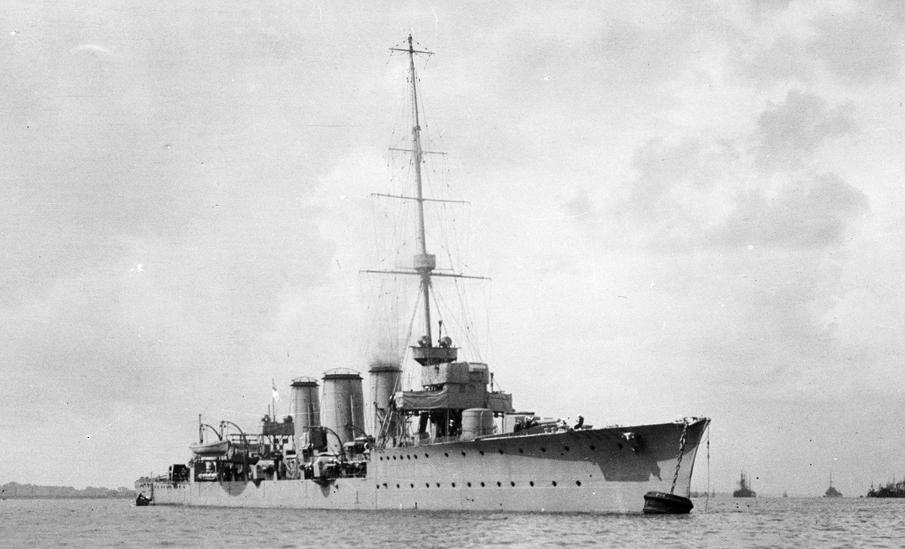
HMS Aurora (1913) British Light Cruiser
HMS Aurora was an Arethusa-class light cruiser built for the Royal Navy before the First World War. Devonport Dockyard constructed her in Plymouth, England. Launched on 30 September 1913, she entered service in September 1914.
Designed for reconnaissance and destroyer flotilla support, Aurora displaced approximately 3,500 tons and could reach speeds of 28.5 knots. Her original armament included two 6-inch guns, six 4-inch guns and four 21-inch torpedo tubes.
Initially, Aurora served with the Harwich Force as leader of the 1st Destroyer Flotilla. In February 1915, she transferred to the 10th Destroyer Flotilla.
On 24 January 1915, Aurora participated in the Battle of Dogger Bank. She was the first British warship to engage German forces during the battle, helping initiate the pursuit that ended with the sinking of SMS Blücher.
In August 1915, Aurora joined the hunt for the German auxiliary minelayer Meteor. The German crew eventually scuttled their vessel to prevent its capture.
Throughout the war, Aurora continued patrols and operations against German naval forces in the North Sea. She was present at the surrender of the German High Seas Fleet in November 1918.
Following the war, the Royal Navy placed Aurora in reserve. On 1 November 1920, she transferred to the Royal Canadian Navy, becoming HMCS Aurora. However, financial restrictions ended her Canadian service in June 1922. After several years laid up at Halifax, Canada sold Aurora for scrapping in August 1927.


As HMCS Aurora (1913)


