
7 Things to See in Walgett
Located at the intersection of the Kamilaroi and Castlereagh Highways in northern New South Wales, Walgett is a small town of around 1,400 people. Similar to other outback Australian towns, art work and attractions have been installed to attract visitors and encourage them to stop and explore. Walgett has a hot, semi-arid climate with hot to very hot summers often over 40 degrees (Celsius). The best time of year to visit is April to October when the daytime temperatures are more bearable.
Travelling though to Lightning Ridge, we stopped for around an hour to see what was on offer.


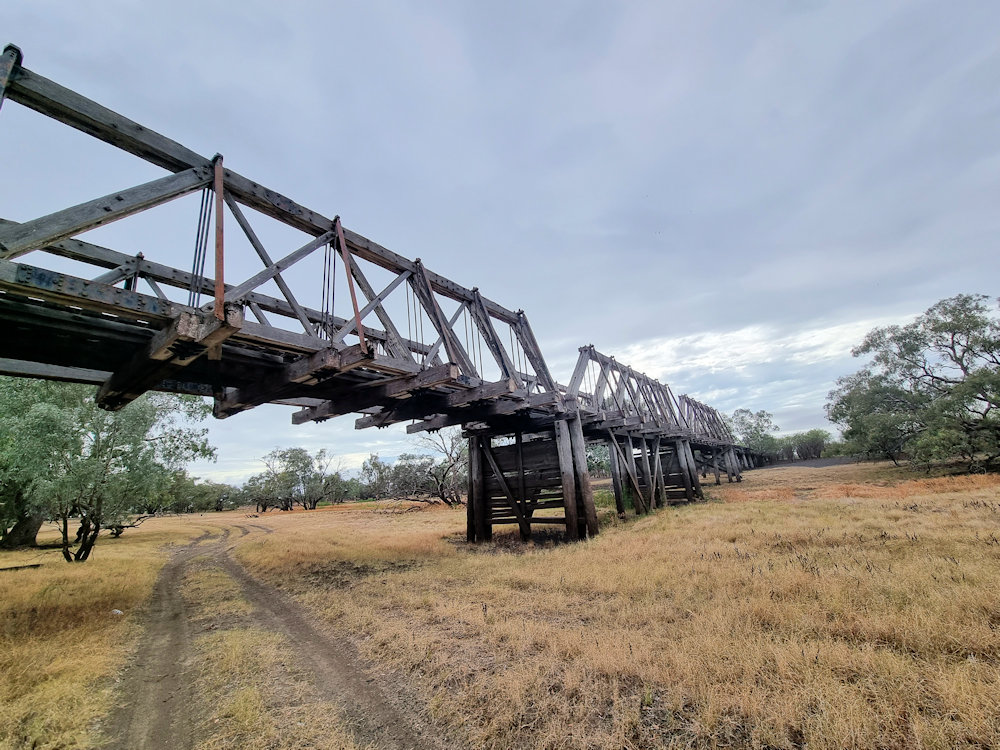
Two Mile Creek Rail Bridge
Spanning approximately 275 meters over the Two Mile Warrambool watercourse, the rail bridge opened in November 1908. Built by the Public Works Department, the bridge was designed by engineer Henry Dean using the Howe Through Truss style of bridge construction. The Two Mile Creek Railway Bridge is one of only three remaining Howe Through Truss rail bridges, the others being at Canowindra and Menah. Like much of New South Wales’ country railway networks, regular passenger services to Walgett ceased in the 1970s, although occasional rail motors travelled the line to Walgett, the last being in 1983. The line received flood damage in November 1987, between Walgett Railway Station and the bridge, and was never repaired.
Freight trains now use the Walgett Wheat Terminal, which is the largest grain storage facility in the Southern Hemisphere and located to the east of the bridge.
Located just north of Walgett, on the Castlereagh Highway, a short track leads to the bridge. If you don’t fell like driving on the dirt, it’s only a short walk. Remember to keep an eye out for snakes as the grass can be long.


Alex Trevallion Park
The park was developed by the Rotary Club of Walgett and named in honour of Alex Trevallion, who served as Shire Clerk of Walgett Shire Council from 1954 to 1969. The naming recognised his civic contributions and service to the local community. A dedication to Trevallion was made in 1985, reflecting the town’s appreciation for his work in local government.
Alex Trevallion Park is an RV-friendly free camping area. Visitors are permitted to stay for up to 48 hours. The site includes level gravel parking areas suitable for caravans and motorhomes as well as grassy shaded sections for tents. Facilities available to travellers include toilets, showers, potable water, a dump point for caravans, and barbecue areas.
One of the distinctive features of the park is a stone engraved with the poem “Been There Before” by the Australian bush poet Banjo Paterson. The engraving reflects the strong association between the Australian outback and the literary traditions that celebrated rural life and travel through the inland regions.
The park also contains a preserved Wolseley Ditch Digger, an early mechanical trenching machine that represents the agricultural and irrigation heritage of the Walgett district. Displayed as a piece of historical machinery, it highlights the importance of engineering innovations in supporting farming and water management in the semi-arid environment of north-western New South Wales.


Street Art
Scattered around the main street, art works brighten up the area.


Water Tower
The Walgett Water Tower mural is one of the most striking pieces of public art in the town of Walgett in north-western New South Wales. Painted on the town’s water tower on Dewhurst Street, the large mural depicts the celebrated Aboriginal musician Jimmy Little. The artwork was completed in November 2020 and has since become a prominent landmark and visitor attraction.
The portrait was painted by artist Jenny McCracken, who based the image on a photograph by John Elliott. The background design was created by local Gamilaroi artist Frank Wright. His design incorporates elements that represent the Walgett region, including the local river systems and cultural totems such as the sand goanna, dragonfly, and emu.

Walgett Bore Baths
The Walgett Bore Baths are a well known public facility located beside the Namoi River. The baths are supplied by naturally heated artesian water drawn from the Great Artesian Basin, which flows from a local bore and keeps the pool warm throughout the year. Because of this constant supply of mineral rich water, the baths have long been valued both for recreation and for their reputed therapeutic qualities.
The bore that supplies the baths was originally drilled in the early twentieth century during a period when many inland towns were tapping into the Great Artesian Basin to secure reliable water supplies. Walgett’s bore produced a strong flow of hot water, and local residents soon recognised its potential as a bathing facility. Over time the site was developed into a public pool where the warm artesian water could be enjoyed by the community.
The Walgett Bore Baths have since become one of the town’s best known attractions. Open year round, the baths provide a popular place for locals and travellers to relax, and enjoy the naturally heated water, particularly during the cooler months.
During our visit, the baths were closed for maintenance, so it’s recommended to check for opening times, if you intend going there.
Located adjacent to the baths is an old table top wagon. These were pulled by bullock drays to transport wool and other goods.


Tracker Walford Walkway
The Tracker Walford Walkway is a scenic riverside walking track on the north side of Walgett. The walkway runs for about 1.5 kilometres along the banks of the Namoi River, beginning near Warrena Street and continuing to the cattle crossing. Shaded by river gums and lined with natural vegetation, it provides a peaceful place for walking, relaxing, and enjoying views of the river and surrounding landscape.
The walkway is named in honour of Norman Walford, often known locally as “Tracker” Walford. He was one of the last Aboriginal trackers employed by the police in New South Wales and spent many years based at Walgett. During his career he assisted police in searches across the state and became widely respected for his remarkable tracking skills. In 1957 he received a commendation from the Commissioner of Police for helping locate a missing man near Brewarrina after a three-day search.
The walkway was created by members of the Walford family and developed in cooperation with Walgett Shire Council and community groups as a tribute to his life and service. Interpretive signs along the track share information about local Aboriginal heritage, the river environment, and the history of the district.

War Memorials
Several war and soldiers’ memorials in Walgett commemorate local men and women who served in Australia’s armed forces. The principal memorial is located in the town centre and honours residents who served in the First and Second World Wars as well as later conflicts.
The memorial records the names of soldiers from the Walgett district who served in the First Australian Imperial Force during the First World War. Like many rural Australian towns, Walgett contributed a significant number of volunteers despite its small population. Additional plaques and memorial features recognise service in the Second World War and later military operations.


Other Places to Visit in New South Wales
To see what else there is to do in New South Wales, click here.
Our photos are available for purchase on


Leave a Reply